Paul LaViolette discussed the physics behind anti-gravity propulsion technology and showed how it is not only possible, but is currently being used in secret projects. "We're sort of being held in a 'technology cage,' on purpose, for fear of change," he said. He detailed some of the early experiments conducted by Nikola Tesla and T. Townsend Brown, who both used electricity to affect gravity. LaViolette noted that, in the mid-1950's, numerous aviation companies were not only attempting to develop anti-gravity technology but were quite open and enthusiastic about it -- until 1959. "Suddenly it was like a blackout in the media," he observed.
BROADCASTED 21 June 2009.
Showing posts with label science. Show all posts
3.29.2010
Antigravity propulsion with Paul LaViolette
Tags:
energy,
free energy,
Paul A. LaViolette,
Physics,
science,
technology,
video,
youtube
WITTS Hemisphere Quantum Generator
Another demonstration of useful freely available electric power derived from the quantum field. No input fuel required! (Original video - 1993) This device is similar to machines developed by Henry Moray using a hemisphere shape.
Tags:
awareness,
Consciousness,
energy,
evolution,
free energy,
Freedom,
science,
technology,
truth,
video,
youtube
3.25.2010
La Revolución Cuántica - Visiones del Futuro
El Dr. Michio Kaku, teórico de física avanzada y futurista, explora la ciencia de vanguardia y la tecnología punta. Este reputado científico demostrará como la humanidad está en un momento decisivo de la historia, al estelarizar una histórica transición de la Era del Descubrimiento a la Era de la Maestría. A través de este especial de History de tres horas, el Dr. Kaku pondrá en evidencia cómo el hombre está dejando de ser un observador pasivo de la naturaleza para asumir un rol activo frente a ella, respaldado por todas estas innovaciones tecnológicas. Mostrará, así mismo, cómo esta inédita coyuntura brinda unas posibilidades incomparables, a la vez que implica grandes responsabilidades. Este reconocido científico se adentrará en La Revolución Cuántica, la cual podría transformar muchas ideas de la ciencia ficción en hechos científicos: desde meta-materiales con propiedades tan asombrosas como la invisibilidad, hasta energía cuántica ilimitada, superconductores a temperatura ambiente y ascensores espaciales! ...como el soñado por Arthur C. Clarke.
3.23.2010
On the Reality of LENR* and the Mythology of Cold Fusion
*Low Energy Nuclear Reaction
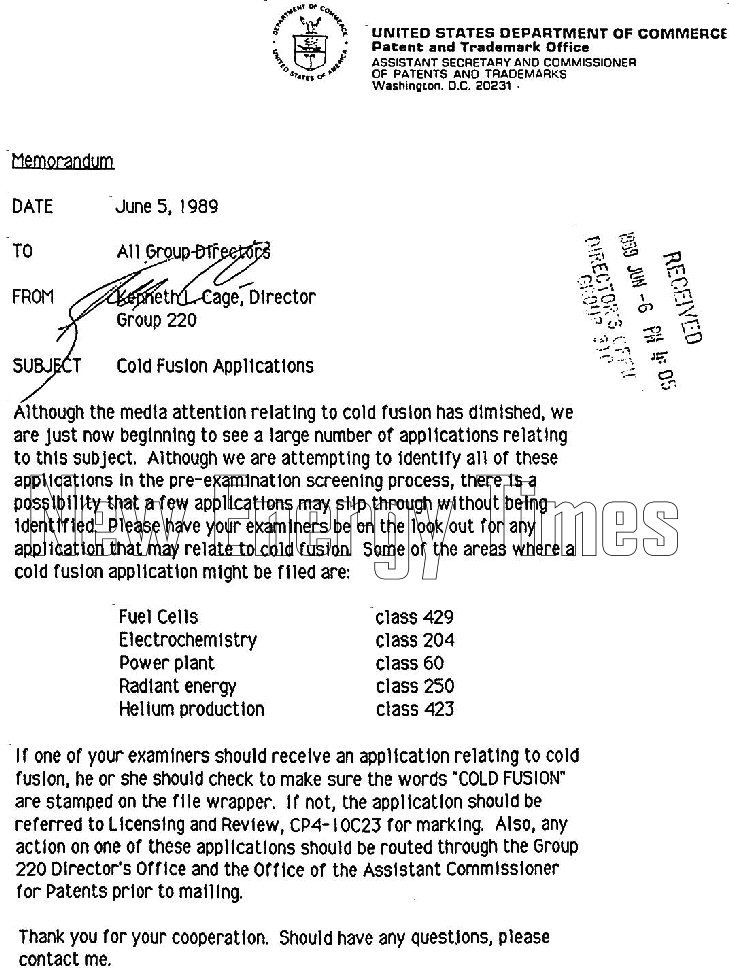
[Below: The US Patent & Trademark Office's (...which is an US Department of Commerce agency!!!) policy on what to do with Cold Fusion patent applications...]
[Below: The US Patent & Trademark Office's (...which is an US Department of Commerce agency!!!) policy on what to do with Cold Fusion patent applications...]

[USPTO's 1989 Cold Fusion Applications Memorandum]
Tags:
energy,
free energy,
fusion,
Physics,
science,
technology,
video,
youtube
3.21.2010
Blacklight Power, A New Energy Source
The BlackLight Process generates more than 200 times the energy of burning hydrogen that can be harnessed to replace the thermal power in coal, oil, gas and nuclear power plants.
Tags:
energy,
free energy,
global paradigm shift,
science,
technology,
video,
youtube
3.17.2010
Mind over Matter
The sixth program from the "Mind Over Matter" series (Thames, 1980), in which eyesight and electron microscope researcher Dr. Kit Pedler and TV presenter, producer and writer Tony Bastable discuss how so-callled "paranormal" mental phenomena is compatible with quantum theory principles.
3.16.2010
New Reactor Uses Sunlight to Turn H2O and CO2 Into Fuel
http://www.popsci.com/science/article/2009-11/co2-recycler-uses-sunlight-turn-waste-carbon-back-fuel

[This is 'old news'. Sandia National Laboratories released this project to the public back in Dec/2007. So, these guys in PopSci must've been 'made' to give out a 'new spin' on a technology the Sandia people were, most likely, trying to put out as a 'commercial solution' to the climategate hoax. All in all, this is good science to keep in mind...]
Scientists at Sandia National Labs, seeking a means to create cheap and abundant hydrogen to power a hydrogen economy, realized they could use the same technology to "reverse-combust" CO2 back into fuel. Researchers still have to improve the efficiency of the system, but they recently demonstrated a working prototype of their "Sunshine to Petrol" machine that converts waste CO2 to carbon monoxide, and then syngas, consuming nothing but solar energy.
The device, boasting the simple title Counter-Rotating-Ring Receiver Reactor Recuperator (we'll go with "CR5") sets off a thermo-chemical reaction by exposing an iron-rich composite to concentrated solar heat. The composite sheds an oxygen molecule when heated and gets one back as it cools.
The cylindrical metal CR5 is divided into hot and cold chambers. Solar energy heats the hot chamber to a scorching 2,700 degrees, hot enough to force the iron oxide composite to lose oxygen atoms. The composite is then thrust into the cool chamber, which is filled with carbon dioxide. As it cools, the iron oxide snatches back its lost oxygen atoms, leaving behind carbon monoxide.
Read more...

[This is 'old news'. Sandia National Laboratories released this project to the public back in Dec/2007. So, these guys in PopSci must've been 'made' to give out a 'new spin' on a technology the Sandia people were, most likely, trying to put out as a 'commercial solution' to the climategate hoax. All in all, this is good science to keep in mind...]
Scientists at Sandia National Labs, seeking a means to create cheap and abundant hydrogen to power a hydrogen economy, realized they could use the same technology to "reverse-combust" CO2 back into fuel. Researchers still have to improve the efficiency of the system, but they recently demonstrated a working prototype of their "Sunshine to Petrol" machine that converts waste CO2 to carbon monoxide, and then syngas, consuming nothing but solar energy.
The device, boasting the simple title Counter-Rotating-Ring Receiver Reactor Recuperator (we'll go with "CR5") sets off a thermo-chemical reaction by exposing an iron-rich composite to concentrated solar heat. The composite sheds an oxygen molecule when heated and gets one back as it cools.
The cylindrical metal CR5 is divided into hot and cold chambers. Solar energy heats the hot chamber to a scorching 2,700 degrees, hot enough to force the iron oxide composite to lose oxygen atoms. The composite is then thrust into the cool chamber, which is filled with carbon dioxide. As it cools, the iron oxide snatches back its lost oxygen atoms, leaving behind carbon monoxide.
Read more...
Tags:
co2,
energy,
Environment,
free energy,
science,
technology,
water
Slo-mo Balloon Bang! - BBC
Dr Yan invents an experiment to find out what puts the bang in a balloon. Even better, he films it with a super slow-mo camera capturing 2,700 frames per second.
3.14.2010
3.11.2010
Genepax - Water 4 Gas
The Water Energy System (WES), generates power by supplying water and air to the fuel and air electrodes using a proprietary technology called the Membrane Electrode Assembly (MEA). The secret behind MEA is a special material that is capable of breaking down water into hydrogen and oxygen through a chemical reaction.
Gas4Free Hydrogen Kit
Simplewaterfuel Hydrogen Fuel Conversion Kit
[Source: www.genepax.com]
Water4Gas Hydrogen Fuel Conversion Kit
Tags:
awareness,
Consciousness,
energy,
evolution,
free energy,
science,
technology,
video,
water,
youtube
Tom Bearden - Docs...
General Relativistic Violation of the Conservation of Energy Law
Proof of a Mechanism for Cold Fusion
[And, a patent application...]
Method, System & Apparatus for Conditioning EM Potentials, Fields & Waves to Treat & Alter Matter
3.09.2010
3.01.2010
2.23.2010
Rocket Waves Destroy Sun Dog
· NASA Astronomy Picture of the Day, 2010 February 23
http://antwrp.gsfc.nasa.gov/apod/image/1002/sdowaves_privon.jpg

http://antwrp.gsfc.nasa.gov/apod/image/1002/sdowaves_privon.jpg

What created those rocket waves, and why did they destroy that sun dog? Close inspection of the above image shows not only a rocket rising near the center, but unusual air ripples around it and a colorful sundog to the far right. The rocket, carrying the Solar Dynamics Observatory (SDO), lifted off two weeks ago from Cape Canaveral, Florida, USA into a cold blue sky. The SDO is designed to observe the Sun continuously over the next several years, exploring the Sun's atmosphere at high resolution and fast time scales. The air ripples -- seen about one minute after launch -- were unexpected, as was the sudden disappearance of the sundog after the ripples passed. Noticed and recorded by several onlookers, there has been much speculation about the origin of the ripples. A leading hypothesis holds that the ripples resulted from a sonic boom created as the rocket broke the sound barrier, which then jumbled a thin layer of ice crystals that were aligned to create the sundog. Lingering questions include why other rocket launches don't produce air ripples as noticeable, and why the ripples appeared more prominent above the rocket. If you know of images of any other aircraft or spacecraft that have produced similar air ripples, please post them to the discussion thread -- they may be help create a better understanding of the effect.
[Source: antwrp.gsfc.nasa.gov]
2.22.2010
2.19.2010
The Hubble Ultra Deep Field in 3D
[What happens when you point the Hubble Space Telescope to a seemingly blank patch of sky? A view that takes you to the edge of the universe!]
Every galaxy in the image is in its proper distance as viewed from the telescope line of sight.
Tags:
Astronomy,
awareness,
conciousness,
Hubble Space Telescope,
image,
science,
Space
2.16.2010
2.15.2010
Dileka - Ionización del agua
http://www.fujisakura.es/dileka.html

[Más info...]
- Activador de Agua EMO
- Double-Blind Test of the Effects of Distant Intention on Water Crystal Formation
- The Great Pyramids - A Free Energy Device?
- Mass Society Drugging - MSM News
- First Osmotic Power Plant Goes Live in Norway
- Diamond Water
- René Quinton (1866–1925)

Dileka es una cañería o tubo empleado para el tratamiento del agua. Mediante este método de depuración se consigue un agua altamente ionizada, sin modificación de su pH, anti-oxidante y anti-bacteriana; además, la estructura física del agua es transformada y su composición se enriquece fuertemente en pequeñas asociaciones de moléculas de agua, fácilmente asimilables, solventes e hidratantes.
Modificaciones físicas del agua
El agua de entrada se conduce a través de los chips AQUAATOM, situados dentro del Dileka formando un patrón en espiral en el sentido de las agujas del reloj. Pasando por estos chips AQUAATOM, el agua genera grandes cantidades de iones tanto positivos como negativos. Los iones negativos generados permanecen en el agua, mientras que los iones positivos son descargados fuera del Dileka a través de tierra.
Ventajas
Piscinas, campos de cultivo, calefacción, torres de refrigeración, industria, lavandería, hospitales, hoteles, ...
[Fuente: www.fujisakura.es]Modificaciones físicas del agua
El agua de entrada se conduce a través de los chips AQUAATOM, situados dentro del Dileka formando un patrón en espiral en el sentido de las agujas del reloj. Pasando por estos chips AQUAATOM, el agua genera grandes cantidades de iones tanto positivos como negativos. Los iones negativos generados permanecen en el agua, mientras que los iones positivos son descargados fuera del Dileka a través de tierra.
Ventajas
- Se suprime la oxidación del agua.
- El agua posee un mayor poder de limpieza.
- El agua resultante tiene más vitalidad.
- El agua posee un coeficiente de calentamiento mayor y por lo tanto tarda menos en calentarse.
- El agua es anti-parasitaria.
- Dileka no necesita fuentes de energía.
- Dileka no contamina y protege el medioambiente.
- Dileka es rentable. Previene la acumulación y la oxidación de sus tubos internos alargando su vida útil. También ayuda en el ahorro de detergentes, champús y jabones domésticos o industriales.
- Dileka no tiene ningún coste de mantenimiento.
Piscinas, campos de cultivo, calefacción, torres de refrigeración, industria, lavandería, hospitales, hoteles, ...
[Más info...]
- Activador de Agua EMO
- Double-Blind Test of the Effects of Distant Intention on Water Crystal Formation
- The Great Pyramids - A Free Energy Device?
- Mass Society Drugging - MSM News
- First Osmotic Power Plant Goes Live in Norway
- Diamond Water
- René Quinton (1866–1925)
Tags:
agua,
awareness,
Consciousness,
Environment,
health,
science,
technology,
water
2.09.2010
The Blue Brain Project
The Blue Brain Project is the first comprehensive attempt to reverse-engineer the mammalian brain, in order to understand brain function and dysfunction through detailed simulations.
[Source: bluebrain.epfl.ch]
Tags:
artificial intelligence,
brain,
computer,
mind,
mind control,
psychiatry,
science,
video,
youtube
2.08.2010
Cognitive Dissonance through Self-Imposed Ignorance
http://scienceblogs.com/cortex/2010/01/cable_news.php
A new paper by Shawn Powers of USC and Mohammed el-Nawawy of Queens University of Charlotte looked at the effect of international cable news on the ideology of its viewers. Not surprisingly, they found that people were only interested in "news" that didn't contradict what they already believed:
Powers and el-Nawawy show that global media consumers tuned in to international news media that they thought would further substantiate their opinions about U.S. policies and culture, and provide them with information on the international issues that they deemed most important. The study found a strong relationship between the participants' attitudes toward U.S. policy and culture and their choice of broadcaster. Those who were dependent on BBC World and especially CNNI were overall more supportive of U.S. foreign policy.
[...]
The Princeton political scientists Christopher Achen and Larry Bartels analyzed survey data from the 1990's to prove this point. During the first term of Bill Clinton's presidency, the budget deficit declined by more than 90 percent. However, when Republican voters were asked in 1996 what happened to the deficit under Clinton, more than 55 percent said that it had increased. What's interesting about this data is that so-called "high-information" voters (these are the Republicans who read the newspaper, watch cable news and can identify their representatives in Congress) weren't better informed than "low-information" voters. According to Bartels, the reason knowing more about politics doesn't erase partisan bias is that voters tend to only assimilate those facts that confirm what they already believe. If a piece of information doesn't follow Republican talking points (and Clinton's deficit reduction didn't fit the "tax and spend liberal" stereotype) then the information is conveniently ignored.
The bleak lesson is that we turn the spotlight of attention into an information-filter, a way to block-out disagreeable points of view. Consider this experiment, which was done in the late 1960's, by the cognitive psychologists Timothy Brock and Joe Balloun.
Brock and Balloun played a group of people a tape-recorded message attacking Christianity. Half of the subjects were regular church-goers while the other half were committed atheists. To make the experiment more interesting, Brock and Balloun added an annoying amount of static (a crackle of white noise) to the recording. However, they allowed listeners to reduce the static by pressing a button, so that the message suddenly became easier to understand. Their results were utterly predicable and rather depressing: the non-believers always tried to remove the static, while the religious subjects actually preferred the message that was harder to hear. Later experiments by Brock and Balloun demonstrated a similar effect with smokers listening to a speech on the link between smoking and cancer. We silence the cognitive dissonance through self-imposed ignorance.
Read more...
Powers and el-Nawawy show that global media consumers tuned in to international news media that they thought would further substantiate their opinions about U.S. policies and culture, and provide them with information on the international issues that they deemed most important. The study found a strong relationship between the participants' attitudes toward U.S. policy and culture and their choice of broadcaster. Those who were dependent on BBC World and especially CNNI were overall more supportive of U.S. foreign policy.
[...]
The Princeton political scientists Christopher Achen and Larry Bartels analyzed survey data from the 1990's to prove this point. During the first term of Bill Clinton's presidency, the budget deficit declined by more than 90 percent. However, when Republican voters were asked in 1996 what happened to the deficit under Clinton, more than 55 percent said that it had increased. What's interesting about this data is that so-called "high-information" voters (these are the Republicans who read the newspaper, watch cable news and can identify their representatives in Congress) weren't better informed than "low-information" voters. According to Bartels, the reason knowing more about politics doesn't erase partisan bias is that voters tend to only assimilate those facts that confirm what they already believe. If a piece of information doesn't follow Republican talking points (and Clinton's deficit reduction didn't fit the "tax and spend liberal" stereotype) then the information is conveniently ignored.
"Voters think that they're thinking, but what they're really doing is inventing facts or ignoring facts so that they can rationalize decisions they've already made."
The bleak lesson is that we turn the spotlight of attention into an information-filter, a way to block-out disagreeable points of view. Consider this experiment, which was done in the late 1960's, by the cognitive psychologists Timothy Brock and Joe Balloun.
Brock and Balloun played a group of people a tape-recorded message attacking Christianity. Half of the subjects were regular church-goers while the other half were committed atheists. To make the experiment more interesting, Brock and Balloun added an annoying amount of static (a crackle of white noise) to the recording. However, they allowed listeners to reduce the static by pressing a button, so that the message suddenly became easier to understand. Their results were utterly predicable and rather depressing: the non-believers always tried to remove the static, while the religious subjects actually preferred the message that was harder to hear. Later experiments by Brock and Balloun demonstrated a similar effect with smokers listening to a speech on the link between smoking and cancer. We silence the cognitive dissonance through self-imposed ignorance.
Subscribe to:
Posts (Atom)


.png)