LASCO - Large Angle Spectrometric COronagraph
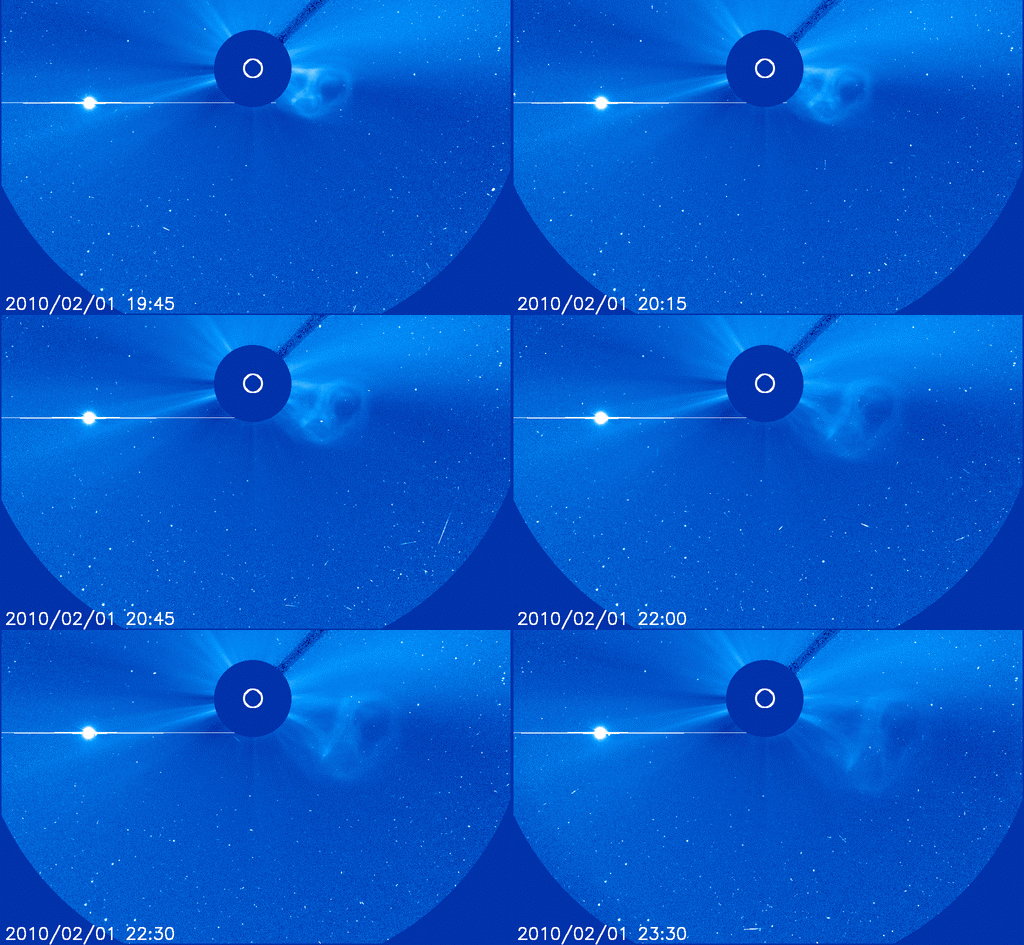
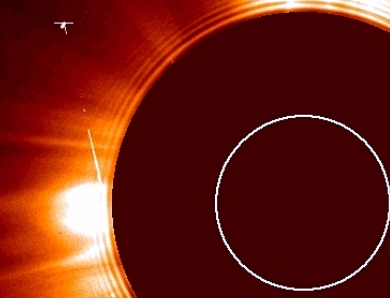
LASCO is able to take images of the solar corona by blocking the light coming directly from the Sun with an occulter disk, creating an artificial eclipse within the instrument itself. The position of the solar disk is indicated in the images by the white circle. The most prominent feature of the corona are usually the coronal streamers, those nearly radial bands that can be seen both in C2 and C3. Occasionally, a coronal mass ejection can be seen being expelled away from the Sun and crossing the fields of view of both coronagraphs. The shadow crossing from the lower left corner to the center of the image is the support for the occulter disk.
- C2 images show the inner solar corona up to 8.4 million kilometers (5.25 million miles) away from the Sun.
[LASCO C2 - 9.18-24.2009]
- C3 images have a larger field of view: They encompass 32 diameters of the Sun. To put this in perspective, the diameter of the images is 45 million kilometers (about 30 million miles) at the distance of the Sun, or half of the diameter of the orbit of Mercury. Many bright stars can be seen behind the Sun.
[LASCO C3 - 9.18-24.2009]
EIT - Extreme ultraviolet Imaging Telescope

From left to right: EIT 171, EIT 195, EIT 284, EIT 304
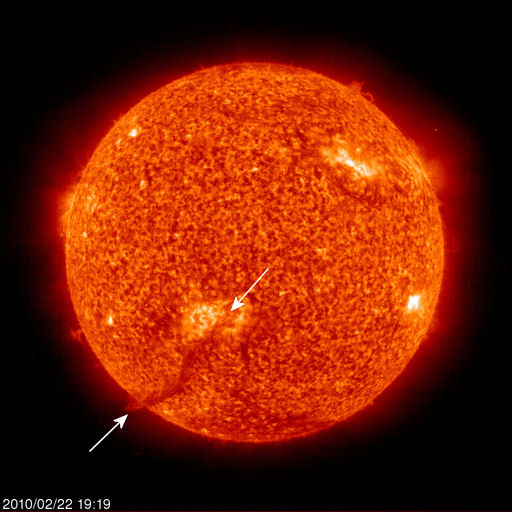
EIT images the solar atmosphere at several wavelengths, and therefore, shows solar material at different temperatures. In the images taken at 304 Angstrom the bright material is at 60,000 to 80,000 degrees Kelvin. In those taken at 171 Angstrom, at 1 million degrees. 195 Angstrom images correspond to about 1.5 million Kelvin, 284 Angstrom to 2 million degrees. The hotter the temperature, the higher you're seeing in the solar atmosphere.
[EIT 195 - 9.21-24.2009]







![Reblog this post [with Zemanta]](http://img.zemanta.com/reblog_c.png?x-id=32affaff-eb48-44a6-8b9f-0b50c9958bf8)
![Reblog this post [with Zemanta]](http://img.zemanta.com/reblog_c.png?x-id=15ecf0c1-9adc-4e0a-baee-179b5e6f8e39)


.png)


