Go to recent INPhobe...
Showing posts with label geometry. Show all posts

2.08.2010

Pentachoron

http://en.wikipedia.org/wiki/Pentachoron
Regular pentachoron, Schlegel diagram (5-cell) (4-simplex) - en.wikipedia.org
Regular pentachoron, Schlegel diagram (5-cell) (4-simplex)

In geometry, the pentachoron is a four-dimensional object bounded by 5 tetrahedral cells. It is also known as the 5-cell, pentatope, or hyperpyramid. It is a 4-simplex, the simplest possible convex regular 4-polytope (four-dimensional analogue of a polyhedron), and is analogous to the tetrahedron in three dimensions and the triangle in two dimensions.
The regular pentachoron is bounded by regular tetrahedra, and is one of the six regular convex polychora, represented by Schläfli symbol {3,3,3}.
The pentachoron is self-dual, and its vertex figure is a tetrahedron. Its maximal intersection with 3-dimensional space is the triangular prism.
A 3D projection of a 5-cell performing a double rotation about two orthogonal planes - en.wikipedia.org
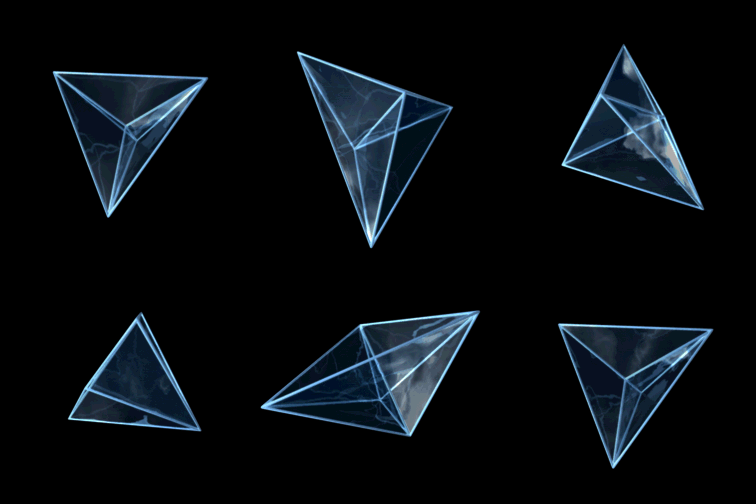
A 3D projection of a 5-cell performing a double rotation about two orthogonal planes

[Source: en.wikipedia.org]
Reblog it with Zemanta...

5.27.2009

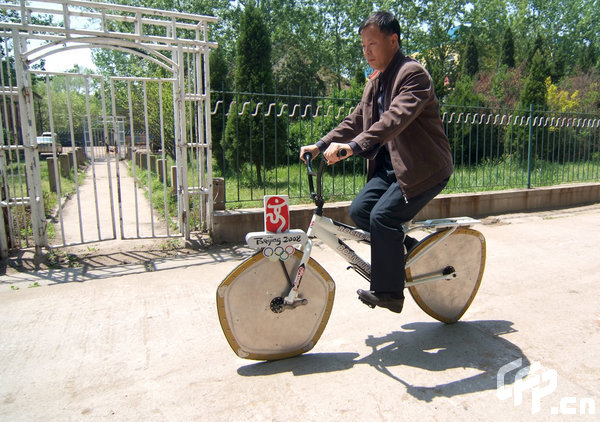
A new bicycle reinvents the wheel, with a pentagon and triangle

·Guan’s bicycle isn’t the first to exploit these shapes — they have been used by urban planners as manholes.
http://technology.timesonline.co.uk/tol/news/tech_and_web/article6366308.ece

It seems a bit crazy to reinvent the wheel, but that is precisely what the Chinese inventor Guan Baihua has done. Although his new set of wheels have a little twist to them. The 50-year-old military officer from Qingdao has devised a rather curious new bicycle. Instead of circular wheels the bike has a pentagonal wheel at the front and a triangular wheel at the back.
[...]
Those who have tried it have been surprised at how smooth the ride is.
That is because the edges of the pentagonal and triangular wheels are not perfectly straight. The sides of the shapes bulge outwards in such a way that the wheels share an important feature with the circle: the diameter across the shapes is the same which ever way that you measure it.
[...]
This means that as I cycle, although the wheel itself does not have a fixed centre of rotation, the saddle of the bike doesn’t bob up and down as you might expect but stays a fixed distance from the ground. To get the exact contours for the shapes, the curved edges are drawn so that they are part of a circle centred on the vertex opposite the edge. They are called Reuleaux polygons after the 19th-century German engineer Franz Reuleaux, who did pioneering work on machines that turn one type of motion into another.
Read more...

A Reuleaux triangle is a curve of constant width. Opposite sides on each square are parallel supporting lines, since each touches the curve but does not intersect the interior. The fact that the Reuleaux triangle can be rotated whilst still just intersecting the boundary shows that width (separation between parallel supporting lines) is constant in all directions.
File:Rouleaux triangle Animation.gif
[Source: wikipedia.org]

5.06.2009

Tesseract (four-dimensional analog of the cube)

http://en.wikipedia.org/wiki/Tesseract
http://upload.wikimedia.org/wikipedia/commons/5/55/8-cell-simple.gifhttp://upload.wikimedia.org/wikipedia/commons/5/55/Tesseract.gif
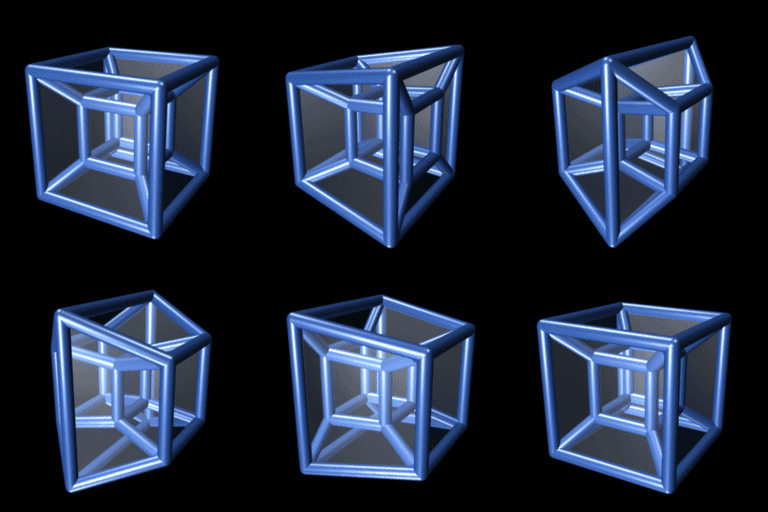
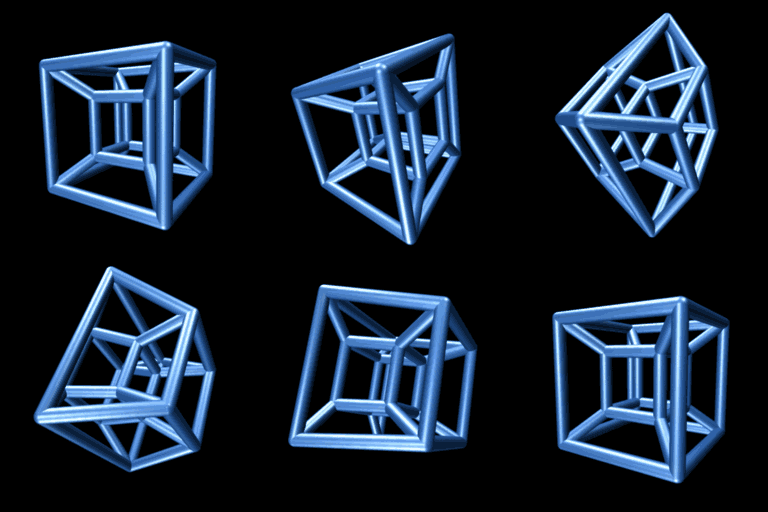
[3D projections of an 8-cell performing, on the left, a simple rotation about a plane which bisects the figure from front-left to back-right and top to bottom; and on the right, a double rotation about two orthogonal planes.]

In geometry, the
tesseract, also called an 8-cell or regular octachoron, is the four-dimensional analog of the cube. The tesseract is to the cube as the cube is to the square. Just as the surface of the cube consists of 6 square faces, the hypersurface of the tesseract consists of 8 cubical cells. The tesseract is one of the six convex regular 4-polytopes.

A generalization of the cube to dimensions greater than three is called a ''Hypercube'', “n-cube” or “measure polytope”. The tesseract is the four-dimensional hypercube, or 4-cube.
According to the Oxford English Dictionary, the word tesseract was coined and first used in 1888 by Charles Howard Clinton in his book A New Era of Thought, from the Greek ''τέσσερεις ακτίνες'' (“four rays”), referring to the four lines from each vertex to other vertices. Some people have called the same figure a “tetracube”, and also simply a "hypercube" (although a hypercube can be of any dimension).
Learn more...
Reblog this post [with Zemanta]