

Relics of the Bo Civilization.
Hanging coffins of the Bo people in Gongxian County of southwest China's Sichuan Province.
Showing posts with label archaeology. Show all posts
Showing posts with label archaeology. Show all posts
3.15.2010
Mysterious Hanging Coffins of China


3.04.2010
Noah's Ark Is (Still) in Turkey
http://www.viewzone.com/noah.html
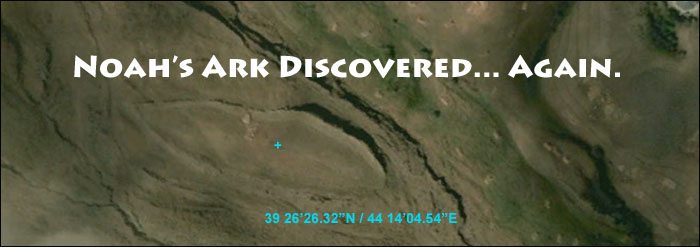
by Dan Eden
I'm often amazed at our lack of knowledge about history. Ordinary people are hungry for this information, yet the organizations responsible to disseminate these facts seem to have an agenda to keep us in the dark. This is especially true when it comes to our ancient human history.
I won't hold you in suspense with this article: The Ark of Noah has been found. It's real. I'll describe the evidence in some detail and end with the historical and religious implications.
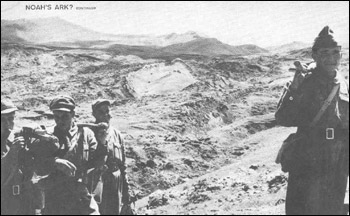
["Noah's Ark?", LIFE, 1960]
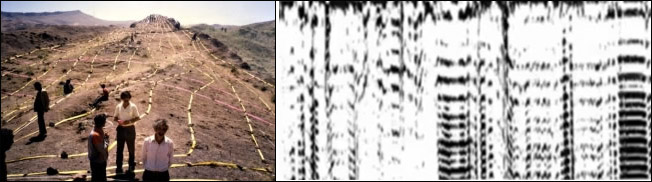
"This data does not represent natural geology. These are man made structures. These reflections are appearing too periodic... too periodic to be random in that type of natural pace."
-- Ron Wyatt of SIR Imaging team.
by Dan Eden
I'm often amazed at our lack of knowledge about history. Ordinary people are hungry for this information, yet the organizations responsible to disseminate these facts seem to have an agenda to keep us in the dark. This is especially true when it comes to our ancient human history.
I won't hold you in suspense with this article: The Ark of Noah has been found. It's real. I'll describe the evidence in some detail and end with the historical and religious implications.
["Noah's Ark?", LIFE, 1960]
In 1960 the picture [above] was published in LIFE magazine under the heading of, Noah's Ark? That same year a group of Americans accompanied Capt. Durupinar to the site for a day and a half. They were expecting to find artifacts on the surface or something that would be unquestionably related to a ship of some kind. They did some digging in the area but found nothing conclusive and announced to the anxiously waiting world that it appeared to be a natural formation.
The discovery
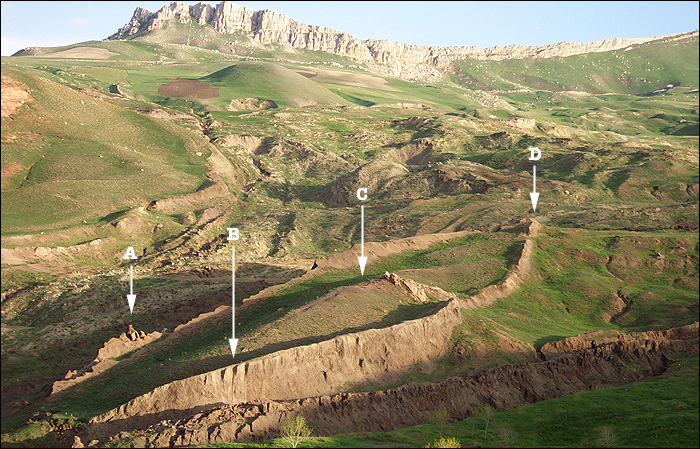
#1 -- the Visual Evidence
[Ark's measurements from bow to stern 515 ft, or exactly 300 Egyptian cubits]
#2 -- Ground Penetrating Radar
[Ground Penetrating Radar survey]
"This data does not represent natural geology. These are man made structures. These reflections are appearing too periodic... too periodic to be random in that type of natural pace."
-- Ron Wyatt of SIR Imaging team.
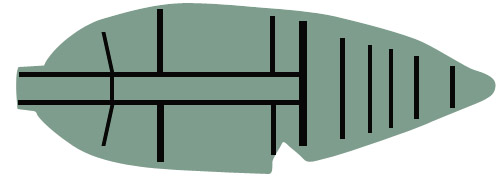
[Schematic of GPR results]
#3 -- Artifacts retrieved from the Ark
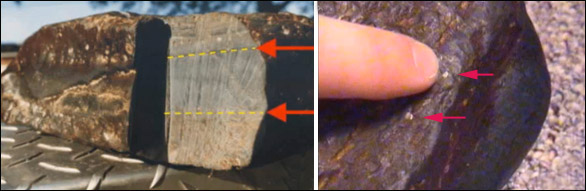
[Laminated planks with nails]
[Iron-aluminum-titanium alloy rivet]
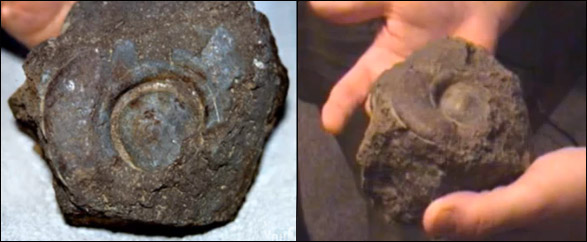
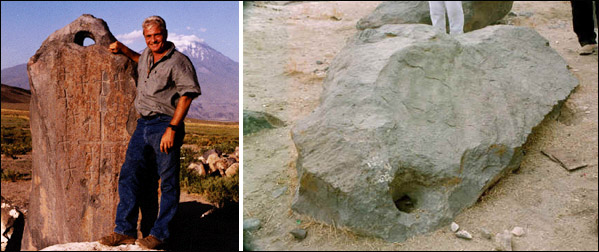
[Stone anchors]
Read more...
2.27.2010
2.17.2010
400-Million-Year-Old Mystery
· Giant Tree-like Object in Epoch Before Trees Existed.
http://www.dailygalaxy.com/my_weblog/2010/02/fossil-mystery-giant-treelike-object-in-epoch-before-trees-existed.html

[Prototaxites Formed from Rolled Liverwort Mats]

http://www.dailygalaxy.com/my_weblog/2010/02/fossil-mystery-giant-treelike-object-in-epoch-before-trees-existed.html
The giant fossil Prototaxites is a big 400-million year old mystery. The fossils resemble tree trunks, and yet they are from a time before trees existed. The stable carbon isotope values are similar to those of fungi, but the fossils do not display structures usually found in fungi. Hence, the enigma.
Prototaxites have sparked controversy for more than a century. Originally classified as a conifer, scientists later argued that it was instead a lichen, various types of algae or a fungus. Whatever it was, it stood in tree-like trunks more than 20 feet tall, making it the largest-known organism on land in its day.
Read more...Prototaxites have sparked controversy for more than a century. Originally classified as a conifer, scientists later argued that it was instead a lichen, various types of algae or a fungus. Whatever it was, it stood in tree-like trunks more than 20 feet tall, making it the largest-known organism on land in its day.
"No matter what argument you put forth, people say, well, that’s crazy. That doesn’t make any sense. A 20-foot-tall fungus doesn’t make any sense. Neither does a 20-foot-tall algae make any sense, but here’s the fossil."
- C. Kevin Boyce, Assistant Professor, Geophysical Sciences, U. of Chicago.
[Prototaxites Formed from Rolled Liverwort Mats]
2.16.2010
Should We Clone Neanderthals?
· The scientific, legal, and ethical obstacles.
http://www.archaeology.org/1003/etc/neanderthals.html
If Neanderthals ever walk the earth again, the primordial ooze from which they will rise is an emulsion of oil, water, and DNA capture beads engineered in the laboratory of 454 Life Sciences in Branford, Connecticut. Over the past 4 years those beads have been gathering tiny fragments of DNA from samples of dissolved organic materials, including pieces of Neanderthal bone. Genetic sequences have given paleoanthropologists a new line of evidence for testing ideas about the biology of our closest extinct relative.
[...]
Newly developed techniques could make cloning Neanderthal cells or body parts a reality within a few years. The ability to use the genes of extinct hominins is going to force the field of paleoanthropology into some unfamiliar ethical territory. There are still technical obstacles, but soon it could be possible to use that long-extinct genome to safely create a healthy, living Neanderthal clone. Should it be done?
[...]
Please, read more...

http://www.archaeology.org/1003/etc/neanderthals.html
by Zach Zorich
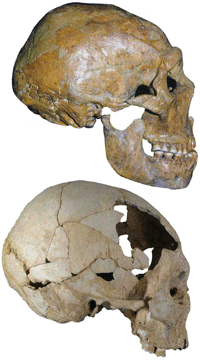
If Neanderthals ever walk the earth again, the primordial ooze from which they will rise is an emulsion of oil, water, and DNA capture beads engineered in the laboratory of 454 Life Sciences in Branford, Connecticut. Over the past 4 years those beads have been gathering tiny fragments of DNA from samples of dissolved organic materials, including pieces of Neanderthal bone. Genetic sequences have given paleoanthropologists a new line of evidence for testing ideas about the biology of our closest extinct relative.
[...]
Newly developed techniques could make cloning Neanderthal cells or body parts a reality within a few years. The ability to use the genes of extinct hominins is going to force the field of paleoanthropology into some unfamiliar ethical territory. There are still technical obstacles, but soon it could be possible to use that long-extinct genome to safely create a healthy, living Neanderthal clone. Should it be done?
[...]
"If your experiment succeeds and you generate a Neanderthal who talks,
you have violated every ethical rule we have,
and if your experiment fails...well. It's a lose-lose."
—James Noonan
"This is a species-altering event,
it changes the way we are creating a new generation."
—Lori Andrews
"I'm convinced that if one were to raise a Neanderthal in a modern
human family he would function just like everybody else,
I have no reason to doubt he could speak and do all the things
that modern humans do."[...so much for evolution.]
-Trenton Holliday
2.15.2010
Secret Caves of the Lizard People
http://strangemaps.wordpress.com/2010/02/08/433-secret-caves-of-the-lizard-people/

Read more...
Did strange people live under LA 5000 years ago?An amazing labyrinth of underground passages and caverns hundreds of feet below the surface of Fort Moore Hill is revealed in maps – all rights to which have been reserved – prepared by G. Warren Shufelt, local mining engineer, who explains his topographical endeavors as being based on results obtained from a radio X-ray perfected by him. In this elaborate system of tunnels and rooms, according to a legend furnished Shufelt by an Indian authority, a tribe of human beings called the Lizard People[...reptilians, anyone?], lived, 5000 years ago. The network of tunnels formed what Indians call the lost Lizard City, according to Shufelt and the legend. Gold tablets on which are written the origin of the human race and other priceless documents are to be found in the tunnels, according to the legend. Shufelt declares his radio X-ray has located the gold. The engineer has dug a shaft 250 feet deep on North Hill street, overlooking North Broadway, Sunset and Spring streets, and intends to dig to 1000 feet in an effort to strike the lost city. Upper right-hand corner inset is Times Staff Artist Ewing’s conception of the Lizard People at work. Lower left, upper inset shows Shufelt and crew at top of shaft, baling water out of their deep excavation. Lower left inset shows Shufelt operating his radio X-ray device.
2.03.2010
Emergence of Civilization and Fall into Patriarchal Dominion
http://www.dhushara.com/paradoxhtm/fall.htm
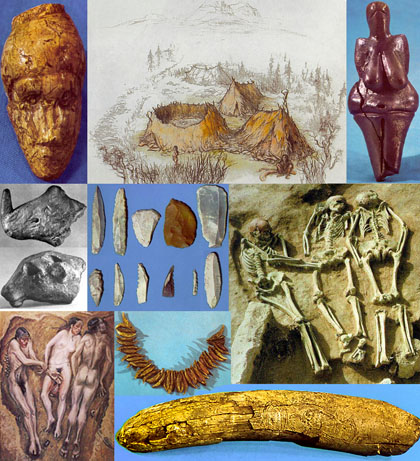
[Dolni Vestonice, in Czech Republic, is a site of an encampment
of mammoth hunters dating from about 30,000 years ago.]
of mammoth hunters dating from about 30,000 years ago.]
There are two sexually polarized theories of human cultural origins, both of which have failed to stand the test of empirical evidence. The first is 'man the hunter' suggesting that male strength and hunting prowess led both to male dominance, and intelligence and culture, through skills of hunting, such as tool-making.
Man the hunter theories are prone to stress male violence and treat women as mere possessions and tradeable items. While they do fit well with our cultural paradigm of male dominance, they do not well-explain the origin of intelligence, nor do they fit well with what we know of so-called primal cultures, where women bring in the majority of the diet by gathering, making them more autonomous as child-rearers than the theory would allow. As a natural successor of the 'killer-ape' theory it gives a pessimistic view of humanity's violence and viability.
The counterpoised matriarchal origin theory is the 'mother-right' proposed by Johan Jakob Bachofen - an evolutionary 'advance' in which an intervening stage of matriarchy led society out of barbarism into modern patriarchy, which he deemed the triumph of superior political and religious thought and organization, despite advocating the incorporation of the 'feminine principle' of nurturance and altruism in modern society. The Swiss philologist proposed an era of 'unregulated hetaerism' in which women were sexually degraded and defenseless, followed by an 'Amazon' revolt that inaugurated an era of matriarchy. In this stage, women created marriage to tame the male. This supposedly still-animalistic and 'backward' era was superseded by a 'higher' stage of human development: patriarchy. He never used the term matriarchy but 'mutterricht' and gynecocracy, for 'rule by women'.
Read more...
Man the hunter theories are prone to stress male violence and treat women as mere possessions and tradeable items. While they do fit well with our cultural paradigm of male dominance, they do not well-explain the origin of intelligence, nor do they fit well with what we know of so-called primal cultures, where women bring in the majority of the diet by gathering, making them more autonomous as child-rearers than the theory would allow. As a natural successor of the 'killer-ape' theory it gives a pessimistic view of humanity's violence and viability.
The counterpoised matriarchal origin theory is the 'mother-right' proposed by Johan Jakob Bachofen - an evolutionary 'advance' in which an intervening stage of matriarchy led society out of barbarism into modern patriarchy, which he deemed the triumph of superior political and religious thought and organization, despite advocating the incorporation of the 'feminine principle' of nurturance and altruism in modern society. The Swiss philologist proposed an era of 'unregulated hetaerism' in which women were sexually degraded and defenseless, followed by an 'Amazon' revolt that inaugurated an era of matriarchy. In this stage, women created marriage to tame the male. This supposedly still-animalistic and 'backward' era was superseded by a 'higher' stage of human development: patriarchy. He never used the term matriarchy but 'mutterricht' and gynecocracy, for 'rule by women'.
1.27.2010
Beneath the Pyramids - Andrew Collins
· Egypt's Greatest Secret Uncovered.
· Exploring Egypt's Underworld for the First Time.
[More info...]
- The Great Pyramids - A Free Energy Device?
- The Egyptologist, the Sphinx and the Cover-up
· Exploring Egypt's Underworld for the First Time.
[...anything Zahi Hawass, Secretary General of the Egyptian Supreme Council of Antiquities, debunks, has got to have interesting 'truths' inside...]
[More info...]
- The Great Pyramids - A Free Energy Device?
- The Egyptologist, the Sphinx and the Cover-up
1.19.2010
Çatalhöyük
http://www.catalhoyuk.com/

Read more...
[As additional information, be aware that two of the main sponsors for this project are Boeing and Shell. Yes, that Boeing and that Shell. 'Finders, keepers...']
The Neolithic site of Çatalhöyük was first discovered in the late 1950s and excavated by James Mellaart between 1961 and 1965. The site rapidly became famous internationally due to the large size and dense occupation of the settlement, as well as the spectacular wall paintings and other art that was uncovered inside the houses.
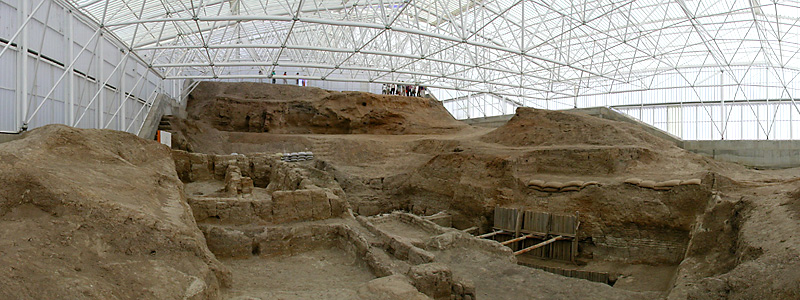
Since 1993 an international team of archaeologists, led by Ian Hodder, has been carrying out new excavations and research, in order to shed more light on the people that inhabited the site.
Since 1993 an international team of archaeologists, led by Ian Hodder, has been carrying out new excavations and research, in order to shed more light on the people that inhabited the site.
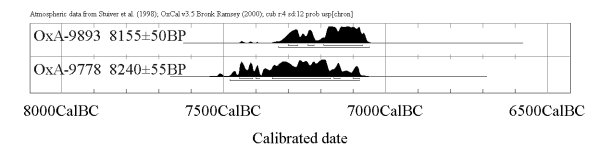
"This year we received the results of a set of AMS radiocarbon dates undertaken at the Oxford Radiocarbon Accelerator Unit. The dates were concerned with the areas excavated in 1999 and are particularly important as they cover the earliest archaeological deposits excavated so far. This produced dates centring around the period c.7,300 to 7,150 calibrated BC for the earliest known archaeological activity at the site (below). [...] We can now estimate that Çatalhöyük was occupied for between 950 and 1,150 years and that individual buildings were typically occupied for between fifty and eighty years, although it appears that they were actually of longer duration earlier on and that this decreased through time." [Radiocarbon Dating, Newsletter 8 of The Çatalhöyük Research Project, Dec 2001]
Read more...
[As additional information, be aware that two of the main sponsors for this project are Boeing and Shell. Yes, that Boeing and that Shell. 'Finders, keepers...']
1.12.2010
12.16.2009
11.18.2009
The Egyptologist, the Sphinx and the Cover-up
The clampdown on excavations at many archaeological sites in Egypt and the inconsistent attitudes of antiquities supremo Dr Zahi Hawass on the existence of tunnels and cavities within the Giza Plateau suggest a hidden agenda is being played out.
http://www.philipcoppens.com/hawass.html
by Philip Coppens
Ten years ago, three books—Giza: The Truth (by Chris Ogilvie-Herald and Ian Lawton), The Stargate Conspiracy (by Lynn Picknett and Clive Prince) and Secret Chamber (by Robert Bauval)—provided an overview of the controversy that was believed to surround the Giza Plateau and the pyramids. The key question was whether it held any undiscovered, or purposefully kept hidden, chambers, whether inside the pyramids or under or near the Sphinx.
The previous decade had seen a renewed interest in the plateau, partly due to the theories of Robert Bauval and Graham Hancock and the discovery of a door in an inaccessible part of the Great Pyramid. It was found on 22 March 1993 by German robotics engineer Rudolf Gantenbrink during the installation of an air conditioning system. The discovery resulted in several claims, allegations and diatribes which, with the dawn of the new millennium, slowly disappeared.
Today, interest in the mysteries of ancient Egypt seems to have waned and peace seems to have been restored. But speak to people in the field and on the ground, and a different picture emerges. It is one of widespread condemnation of the Supreme Council of Antiquities (SCA) and specifically of Dr Zahi Hawass, who has been its Secretary General since 2002. Remarkably, many Egyptian archaeologists argue that the organisation rules with dictatorial control, and that this is but the tip of an iceberg of coverups, slander, embezzlement and perhaps more. Ten years on, no one seems to be writing about it but the situation is at least as bad as back in 1999.
The Supreme Council of Antiquities is part of the Egyptian Ministry of Culture and is responsible for the conservation, protection and regulation of all antiquities and archaeological excavations in Egypt. Over the past decade, a television viewer might be forgiven for believing that there is only one Egyptologist, and that man is Hawass. In truth, Hawass is more of an administrator than an archaeologist; one might even argue that if the man had enough time to lead excavations, he would not be fulfilling his task as administrator. But a television camera has the same attraction as light to a moth. Hawass is a controversial figure. He was at the centre of contention in the 1990s, and remains so today—now, more so in Egypt than abroad.
In the 1990s, Hugh Lynn Cayce reportedly said, according to Edgar Cayce biographer A. Robert Smith: "I got him [Zahi Hawass] a scholarship at the University of Pennsylvania in Egyptology, to get his PhD. I got the scholarship through an ARE person who happened to be on the Fulbright scholarship board."1 Hawass strongly denies this, though it is a fact that he was admitted to the University of Pennsylvania through this scholarship. (Note: ARE is the Association for Research and Enlightenment, an organisation set up to promote the work of the American "sleeping prophet" Edgar Cayce.)
The ARE is interested in the Giza Plateau because, in the 1920s, Edgar Cayce proclaimed that a "Hall of Records", containing information about the lost civilisation of Atlantis, was hidden underneath the Giza Plateau near the Sphinx.
[Also covered in the article...]
Please, read more...Ten years ago, three books—Giza: The Truth (by Chris Ogilvie-Herald and Ian Lawton), The Stargate Conspiracy (by Lynn Picknett and Clive Prince) and Secret Chamber (by Robert Bauval)—provided an overview of the controversy that was believed to surround the Giza Plateau and the pyramids. The key question was whether it held any undiscovered, or purposefully kept hidden, chambers, whether inside the pyramids or under or near the Sphinx.
The previous decade had seen a renewed interest in the plateau, partly due to the theories of Robert Bauval and Graham Hancock and the discovery of a door in an inaccessible part of the Great Pyramid. It was found on 22 March 1993 by German robotics engineer Rudolf Gantenbrink during the installation of an air conditioning system. The discovery resulted in several claims, allegations and diatribes which, with the dawn of the new millennium, slowly disappeared.
Today, interest in the mysteries of ancient Egypt seems to have waned and peace seems to have been restored. But speak to people in the field and on the ground, and a different picture emerges. It is one of widespread condemnation of the Supreme Council of Antiquities (SCA) and specifically of Dr Zahi Hawass, who has been its Secretary General since 2002. Remarkably, many Egyptian archaeologists argue that the organisation rules with dictatorial control, and that this is but the tip of an iceberg of coverups, slander, embezzlement and perhaps more. Ten years on, no one seems to be writing about it but the situation is at least as bad as back in 1999.
The Supreme Council of Antiquities is part of the Egyptian Ministry of Culture and is responsible for the conservation, protection and regulation of all antiquities and archaeological excavations in Egypt. Over the past decade, a television viewer might be forgiven for believing that there is only one Egyptologist, and that man is Hawass. In truth, Hawass is more of an administrator than an archaeologist; one might even argue that if the man had enough time to lead excavations, he would not be fulfilling his task as administrator. But a television camera has the same attraction as light to a moth. Hawass is a controversial figure. He was at the centre of contention in the 1990s, and remains so today—now, more so in Egypt than abroad.
In the 1990s, Hugh Lynn Cayce reportedly said, according to Edgar Cayce biographer A. Robert Smith: "I got him [Zahi Hawass] a scholarship at the University of Pennsylvania in Egyptology, to get his PhD. I got the scholarship through an ARE person who happened to be on the Fulbright scholarship board."1 Hawass strongly denies this, though it is a fact that he was admitted to the University of Pennsylvania through this scholarship. (Note: ARE is the Association for Research and Enlightenment, an organisation set up to promote the work of the American "sleeping prophet" Edgar Cayce.)
The ARE is interested in the Giza Plateau because, in the 1920s, Edgar Cayce proclaimed that a "Hall of Records", containing information about the lost civilisation of Atlantis, was hidden underneath the Giza Plateau near the Sphinx.
[Also covered in the article...]
- Foreign Affairs
- Keeping the Sphinx's Paws Dry
- Scandal at the Supreme Council
- Robots and Slaves
- Suppression and Disinformation
- Egyptology under Challenge

11.03.2009
Ancient Human Metropolis Found in Africa
http://www.viewzone.com/adamscalendar.html
Dating of the Site
http://www.viewzone.com/adamscalendar22.html
Read more...
Who made the metropolis? And why?
http://www.viewzone.com/adamscalendar33.html

The origins of modern humans
http://www.viewzone.com/adamscalendar44.html
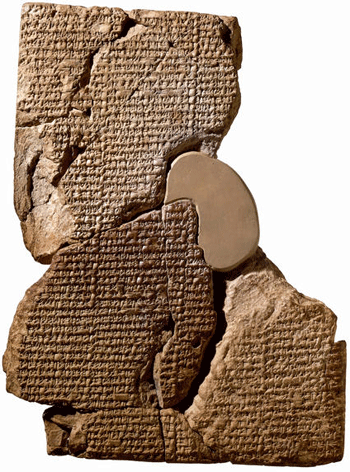
The creation of man seems to be described as a type of cloning and what we would today consider in vitro fertilization.
The result was a hybrid or "evolved human" with enhanced intellect who could perform the physical duties of the worker gods and also take care of the needs of all the gods.
We are told, in other texts, that the expedition came for gold and that great quantities were mined and shipped off the planet. The community in South Africa was called "Abzu" and was the prime location of the mining operation.
Since these events appear to coincide with the dates of "Mitochondrial Eve" (i.e. 150,000 to 250,000 BP) and appear to be located in the richest gold mining region on the planet (Abzu), some researchers are thinking that the Sumerian legends may, in fact, be based on historical events.

by Dan Eden
They have always been there. People noticed them before. But no one could remember who made them -- or why? Until just recently, no one even knew how many there were. Now they are everywhere -- thousands -- no, hundreds of thousands of them! And the story they tell is the most important story of humanity. But it's one we might not be prepared to hear.
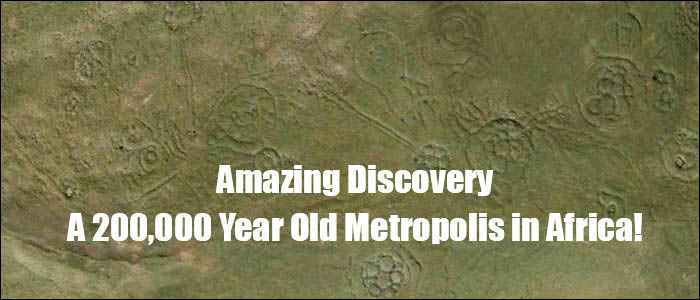
Something amazing has been discovered in an area of South Africa, about 150 miles inland, west of the port of Maputo. It is the remains of a huge metropolis that measures, in conservative estimates, about 1500 square miles. It's part of an even larger community that is about 10,000 square miles and appears to have been constructed -- are you ready -- from 160,000 to 200,000 BCE!
The image [above] is a close-up view of just a few hundred meters of the landscape taken from google-earth. The region is somewhat remote and the "circles" have often been encountered by local farmers who assumed they were made by some indigenous people in the past. But, oddly, no one ever bothered to inquire about who could have made them or how old they were.
Read more...They have always been there. People noticed them before. But no one could remember who made them -- or why? Until just recently, no one even knew how many there were. Now they are everywhere -- thousands -- no, hundreds of thousands of them! And the story they tell is the most important story of humanity. But it's one we might not be prepared to hear.
Something amazing has been discovered in an area of South Africa, about 150 miles inland, west of the port of Maputo. It is the remains of a huge metropolis that measures, in conservative estimates, about 1500 square miles. It's part of an even larger community that is about 10,000 square miles and appears to have been constructed -- are you ready -- from 160,000 to 200,000 BCE!
The image [above] is a close-up view of just a few hundred meters of the landscape taken from google-earth. The region is somewhat remote and the "circles" have often been encountered by local farmers who assumed they were made by some indigenous people in the past. But, oddly, no one ever bothered to inquire about who could have made them or how old they were.
Dating of the Site
http://www.viewzone.com/adamscalendar22.html
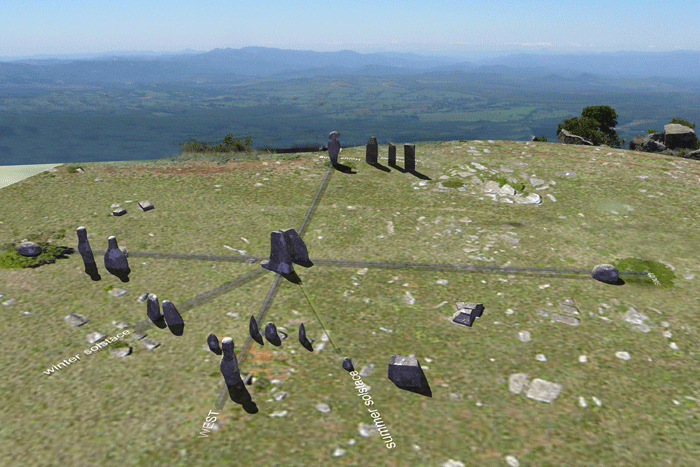
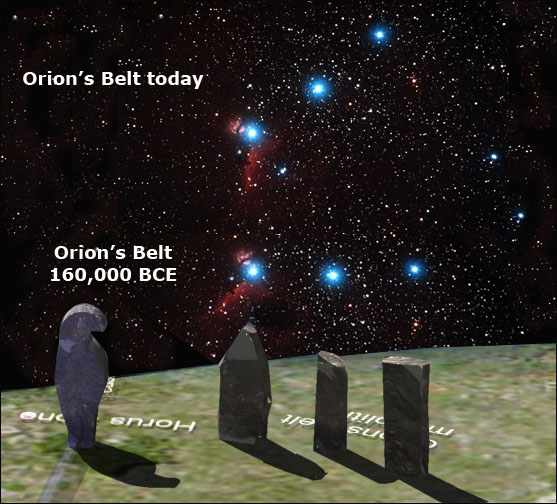
The Earth wobbles on its axis and so the stars and constellations change their angle of presentation in the night sky on a cyclical basis. This rotation, called the precession completes a cycle about every 26,000 years. By determining when the three stars of Orion's belt were positioned flat (horizontal) against the horizon, we can estimate the time when the three stones in the calendar were in alignment with these conspicuous stars.
Read more...
Who made the metropolis? And why?
http://www.viewzone.com/adamscalendar33.html
The name of the first [river] is Pishon;
it flows around the whole land of Havilah,
where there is gold.
· Genesis 2:11 ·
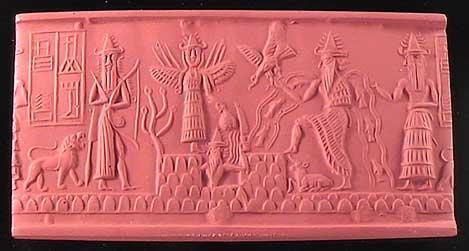
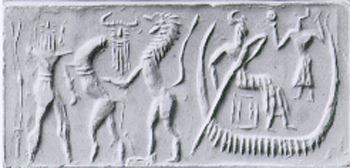
Like Genesis, the Sumerian legend, Atrahasis, tells the story of the creation of modern humans -- not by a loving God -- but by beings from another planet who needed "slave workers" to help them mine gold on their extra-planetary expedition!
Read more...The origins of modern humans
http://www.viewzone.com/adamscalendar44.html
Belit-ili the womb-goddess is present,
Let the womb-goddess create offspring,
And let man bear the load of the gods!
· Dalley 14-15, Atrahasis ·
He [Enki] trod the clay in her presence;
She kept reciting an incantation,
For Enki, staying in her presence, made her recite it.
When she had finished her incantation,
She pinched off fourteen pieces of clay,
And set seven pieces on the right,
Seven on the left.
Between them she put down a mud brick.
· Dalley 16, Atrahasis ·
The result was a hybrid or "evolved human" with enhanced intellect who could perform the physical duties of the worker gods and also take care of the needs of all the gods.
We are told, in other texts, that the expedition came for gold and that great quantities were mined and shipped off the planet. The community in South Africa was called "Abzu" and was the prime location of the mining operation.
Since these events appear to coincide with the dates of "Mitochondrial Eve" (i.e. 150,000 to 250,000 BP) and appear to be located in the richest gold mining region on the planet (Abzu), some researchers are thinking that the Sumerian legends may, in fact, be based on historical events.
10.25.2009
10.22.2009
10.14.2009
10.13.2009

9.22.2009
The mysterious Ipiutak civilization
http://explorenorth.com/articles/billjones/ipiutak.html

![Reblog this post [with Zemanta]](http://img.zemanta.com/reblog_c.png?x-id=62676466-7ca0-4fa1-92e9-b455ec137663)
The Ipiutak poses a puzzling dilemma to archeology.
The lack of artifacts makes the time line of its existence speculative. The hundreds of lodge pits comprise the only evidence of the Ipiutak peoples' existence. The size of the city is another puzzler. It is the largest settlement ever found to have existed in Alaska prior to the arrival of Europeans. Moreover, no other settlement even near its size existed across the expanse of Canada until that country was settled by Europeans. It is a difficult site to explore for there are problems of digging through the frozen earth there. Their dating of the site is admittedly a guess. The Ipiutak could have been there thousands of years before. By the University of Alaska's count there were some 800 lodge pits at the Ipiutak site. These were their permanent lodges. So, let us envision a city of some 1600 lodges of both types. And, we will estimate that each lodge housed a family of five. Then the Ipiutak town must have had a population of 8,000 people! Hardly anything is known about the Ipiutak people except that they existed there at least 3,000 years ago.
Hardly anything is known about the Ipiutak people except that they existed there at least 3,000 years ago. Was this the only Ipiutak town? Well, the Ipiutak certainly were not roving bands. They had a culture that was sophisticated enough to cause them to coalesce into a very large community, larger than any arctic coastal village of either Alaska or Canada today. Such a culture does not develop in one place. There must have been other Ipiutak towns, many of them! But, where are they?
Read more...The lack of artifacts makes the time line of its existence speculative. The hundreds of lodge pits comprise the only evidence of the Ipiutak peoples' existence. The size of the city is another puzzler. It is the largest settlement ever found to have existed in Alaska prior to the arrival of Europeans. Moreover, no other settlement even near its size existed across the expanse of Canada until that country was settled by Europeans. It is a difficult site to explore for there are problems of digging through the frozen earth there. Their dating of the site is admittedly a guess. The Ipiutak could have been there thousands of years before. By the University of Alaska's count there were some 800 lodge pits at the Ipiutak site. These were their permanent lodges. So, let us envision a city of some 1600 lodges of both types. And, we will estimate that each lodge housed a family of five. Then the Ipiutak town must have had a population of 8,000 people! Hardly anything is known about the Ipiutak people except that they existed there at least 3,000 years ago.
Hardly anything is known about the Ipiutak people except that they existed there at least 3,000 years ago. Was this the only Ipiutak town? Well, the Ipiutak certainly were not roving bands. They had a culture that was sophisticated enough to cause them to coalesce into a very large community, larger than any arctic coastal village of either Alaska or Canada today. Such a culture does not develop in one place. There must have been other Ipiutak towns, many of them! But, where are they?
The Prehistoric Alignment of World Wonders - The Great Circle
http://home.hiwaay.net/~jalison/
![Reblog this post [with Zemanta]](http://img.zemanta.com/reblog_c.png?x-id=a197b02d-0329-474d-b54a-91fef3d00701)
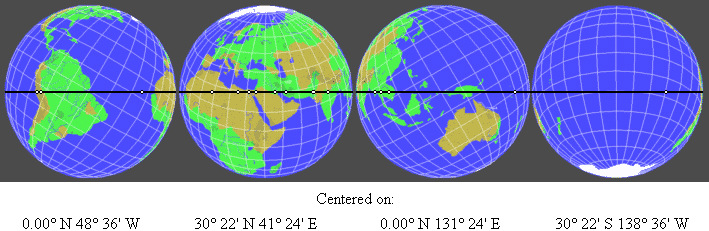
Easter Island, Nazca, Ollantaytambo, Paratoari, Tassili n'Ajjer and Giza are all aligned on a single Great Circle. Additional ancient sites that are located within one tenth of one degree of this Great Circle include Petra; Perseopolis; Khajuraho; Pyay, Sukothai and Anatom Island.
Near Ollantaytambo, Machupicchu and Cuzco are within one quarter of a degree. The Oracle at Siwa in the western Egyptian desert is within one quarter of a degree. In the Indus Valley, Mohenjo Daro and Ganweriwala are within one quarter of a degree. The ancient Sumerian city of Ur and Angkor temples in Cambodia and Thailand are within one degree of the Great Circle. The Angkor temple at Preah Vihear is within one quarter of a degree.
This Circle crosses over the source and the mouth of the Amazon, the dividing line between upper and lower Egypt, the mouth of the Tigris-Euphrates, the Indus River and the Bay of Bengal near the mouth of the Ganges. The Circle also crosses over a number of areas of the world that are largely unexplored, including the Sahara Desert, the Brazilian Rainforest, the highlands of New Guinea, and underwater areas of the North Atlantic Ocean, the South Pacific Ocean and the South China Sea.
Read more... Near Ollantaytambo, Machupicchu and Cuzco are within one quarter of a degree. The Oracle at Siwa in the western Egyptian desert is within one quarter of a degree. In the Indus Valley, Mohenjo Daro and Ganweriwala are within one quarter of a degree. The ancient Sumerian city of Ur and Angkor temples in Cambodia and Thailand are within one degree of the Great Circle. The Angkor temple at Preah Vihear is within one quarter of a degree.
This Circle crosses over the source and the mouth of the Amazon, the dividing line between upper and lower Egypt, the mouth of the Tigris-Euphrates, the Indus River and the Bay of Bengal near the mouth of the Ganges. The Circle also crosses over a number of areas of the world that are largely unexplored, including the Sahara Desert, the Brazilian Rainforest, the highlands of New Guinea, and underwater areas of the North Atlantic Ocean, the South Pacific Ocean and the South China Sea.
Subscribe to:
Posts (Atom)


.png)


