

·Mitochondrial dysfunction, impaired oxidative-reduction activity, degeneration, and death in human neuronal and fetal cells induced by low-level exposure to thimerosal and other metal compounds.
http://charlieinwonderland.com/?p=1380
http://dprogram.net/2009/07/10/new-study-proves-thimerosal-induces-autism-like-neurotoxicity/
http://www.informaworld.com/smpp/content~content=a910652305~db=all~jumptype=rss

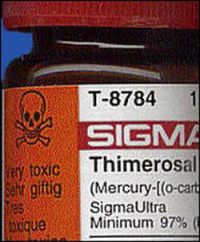
A new study, “A Mitochondrial Dysfunction, Impaired Oxidative-Reduction Activity, Degeneration, and Death in Human Neuronal and Fetal Cells Induced by Low-Level Exposure to Thimerosal and Other Metal Compounds”, published in the most recent issue of the peer-reviewed journal of Toxicology & Environmental Toxicology, confirms a causal connection between Thimerosal and the brain pathology found in patients diagnosed with an autism spectrum disorder (ASD).
[...]
This study showed Thimerosal-induced cellular damage in human neuronal and fetal-cell model systems in a concentration- and time-dependent fashion using Thimerosal at low nanomolar (parts-per-billion) concentrations. These concentrations are comparable to those found in fetal and early infant exposure to mercury from Thimerosal-containing biologics and vaccines in the 1990s and, in some instances, today. These levels induced significant cellular toxicity in the human neuronal and fetal cells studied. The Thimerosal-induced cellular damage was consistent with that found in pathophysiological studies of patients diagnosed with an ASD. In both instances, the studies found significant mitochondrial dysfunction, reduced cellular oxidative-reduction activity, cell degeneration, and cell death.
The present study also revealed that Thimerosal is significantly more toxic than the other metal compounds studied (e.g., aluminum sulfate, methylmercury hydroxide, lead acetate, and mercuric chloride). The explanation for Thimerosal’s greater toxicity than even methylmercury hydroxide (MeHgOH) appears to be the fact that Thimerosal was chemically engineered in the 1920s to be a more highly toxic alkylmercury compound, whose biological transport and intracellular delivery properties were enhanced. Compared to MeHgOH, Thimerosal has: 1) higher aqueous solubility (i.e. ability to dissolve in water and water-based systems); 2) higher solubility in cell membranes (i.e. ability to dissolve in cell membranes); and 3) higher intracellular toxicity (i.e. ability to inactivate essential cell processes) and mercury retention.
Read more...[...]
This study showed Thimerosal-induced cellular damage in human neuronal and fetal-cell model systems in a concentration- and time-dependent fashion using Thimerosal at low nanomolar (parts-per-billion) concentrations. These concentrations are comparable to those found in fetal and early infant exposure to mercury from Thimerosal-containing biologics and vaccines in the 1990s and, in some instances, today. These levels induced significant cellular toxicity in the human neuronal and fetal cells studied. The Thimerosal-induced cellular damage was consistent with that found in pathophysiological studies of patients diagnosed with an ASD. In both instances, the studies found significant mitochondrial dysfunction, reduced cellular oxidative-reduction activity, cell degeneration, and cell death.
The present study also revealed that Thimerosal is significantly more toxic than the other metal compounds studied (e.g., aluminum sulfate, methylmercury hydroxide, lead acetate, and mercuric chloride). The explanation for Thimerosal’s greater toxicity than even methylmercury hydroxide (MeHgOH) appears to be the fact that Thimerosal was chemically engineered in the 1920s to be a more highly toxic alkylmercury compound, whose biological transport and intracellular delivery properties were enhanced. Compared to MeHgOH, Thimerosal has: 1) higher aqueous solubility (i.e. ability to dissolve in water and water-based systems); 2) higher solubility in cell membranes (i.e. ability to dissolve in cell membranes); and 3) higher intracellular toxicity (i.e. ability to inactivate essential cell processes) and mercury retention.
[Here, the article from dprogram.net]
[And here the study, as published on informaworld.com]


.png)





