

Showing posts with label sun. Show all posts
Showing posts with label sun. Show all posts
3.26.2010


2.23.2010
Solar Box Cooker
http://homemadesolar.net/concentrator/solar-box-cooker/


[For complete instructions, go to: homemadesolar.net]
Solar box cookers or solar box ovens are one of the easiest cookers to make, and they are very effective. You’ll need a few cardboard boxes, some foil, non toxic black paint, white glue, and an oven cooking bag.
[Via Sabri]
Sun, Large Prominence and Connected Filament - 02.21.2010
The Solar and Heliospheric Observatory (SOHO) is tracking an enormous magnetic filament on the sun. It stretches more than one million kilometers from end to end, which makes it an easy target for backyard solar telescopes.
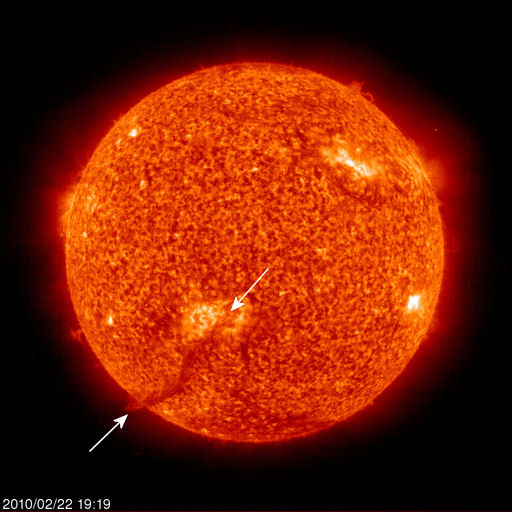
SOHO, ESA & NASA

C. Swiger & J. Stetson, Portland-ME

Alan Friedman, Buffalo-NY

2.04.2010
1.05.2010
12.17.2009


12.07.2009
11.01.2009
10.28.2009
10.25.2009
10.11.2009
Vitamin D - What The Pharmaceutical Industry Doesn't Want You to Know!
Dr. John Cannell on vitamin D.
Vitamin D prevents osteoporosis, depression, prostate cancer, breast cancer, and even effects diabetes and obesity. Vitamin D is perhaps the single most underrated nutrient in the world of nutrition. That's probably because it's free: your body makes it when sunlight touches your skin. Drug companies can't sell you sunlight, so there's no promotion of its health benefits. Truth is, most people don't know the real story on vitamin D and health.
Vitamin D prevents osteoporosis, depression, prostate cancer, breast cancer, and even effects diabetes and obesity. Vitamin D is perhaps the single most underrated nutrient in the world of nutrition. That's probably because it's free: your body makes it when sunlight touches your skin. Drug companies can't sell you sunlight, so there's no promotion of its health benefits. Truth is, most people don't know the real story on vitamin D and health.
9.16.2009


![Reblog this post [with Zemanta]](https://lh3.googleusercontent.com/blogger_img_proxy/AEn0k_tl3Bkd5XKe-SXQJIVWEdFgvkfjSSMQzpd3sCY49p7RGOOkjQzfdnnB6R3DAM_cu9SUheDEN07Hg_Nb4FW7zzgVFeDqXR-45wA1qqo8nt3lgTrS5etI05M5YiBqjNihlFMGUhom0NWP5VoKhOxUhVBa=s0-d)
9.03.2009
Geomagnetic Mega Storm
http://spaceweather.com/
![Reblog this post [with Zemanta]](https://lh3.googleusercontent.com/blogger_img_proxy/AEn0k_uyzEHEPrSvjERFzfEMsx48CwEb1b1S3VJfNYt9iyiqJtj9c2g98c2wK1EupUrzkNPXoB-Z-uqlwmn8OsPjZzyYG5nPY4nwtmhwFJO8OyDSShYch-K5e3IRErAiXFH5DqdK5ak68L1ZmcYxe71u5WM=s0-d)
On Sept. 2nd, a billion-ton coronal mass ejection (CME) slammed into Earth's magnetic field. Campers in the Rocky Mountains woke up in the middle of the night, thinking that the glow they saw was sunrise. No, it was the Northern Lights. People in Cuba read their morning paper by the red illumination of aurora borealis. Earth was peppered by particles so energetic, they altered the chemistry of polar ice.
Read more...8.28.2009
Small Fluctuations In Solar Activity, Large Influence On Climate
http://www.sciencedaily.com/releases/2009/08/090827141349.htm

![Reblog this post [with Zemanta]](https://lh3.googleusercontent.com/blogger_img_proxy/AEn0k_vf08MNxmyC_zZG_IPF4gU170g2kO7teyaI4KQ9wdkYclAYlHcXeLsgu9bw55wkFhw1SxvaxA94YSpCV295-wFtgyP2eY32YF2IhdjY9rSbbR3Yj2xqZGUzvVwYp-N-0lJZ-tTquPtzaq-j3a7PFZRr=s0-d)
An international team of scientists led by the National Center for Atmospheric Research (NCAR) used more than a century of weather observations and three powerful computer models to tackle one of the more difficult questions in meteorology: if the total energy that reaches Earth from the Sun varies by only 0.1 percent across the approximately 11-year solar cycle, how can such a small variation drive major changes in weather patterns on Earth?
The answer, according to the new study, has to do with the Sun's impact on two seemingly unrelated regions. Chemicals in the stratosphere and sea surface temperatures in the Pacific Ocean respond during solar maximum in a way that amplifies the Sun's influence on some aspects of air movement. This can intensify winds and rainfall, change sea surface temperatures and cloud cover over certain tropical and subtropical regions, and ultimately influence global weather.
"The Sun, the stratosphere, and the oceans are connected in ways that can influence events such as winter rainfall in North America," says NCAR scientist Gerald Meehl, the lead author. "Understanding the role of the solar cycle can provide added insight as scientists work toward predicting regional weather patterns for the next couple of decades."
Read more...The answer, according to the new study, has to do with the Sun's impact on two seemingly unrelated regions. Chemicals in the stratosphere and sea surface temperatures in the Pacific Ocean respond during solar maximum in a way that amplifies the Sun's influence on some aspects of air movement. This can intensify winds and rainfall, change sea surface temperatures and cloud cover over certain tropical and subtropical regions, and ultimately influence global weather.
"The Sun, the stratosphere, and the oceans are connected in ways that can influence events such as winter rainfall in North America," says NCAR scientist Gerald Meehl, the lead author. "Understanding the role of the solar cycle can provide added insight as scientists work toward predicting regional weather patterns for the next couple of decades."
7.09.2009
Sun's storms set to intensify
http://www.gympietimes.com.au/story/2009/07/07/magnetic-storms-on-the-suns-surface-are-set-to-int/


[Look closely at date and time]
[Also visit Japan's Solar Real-time Magnetosphere Simulation, at www2.nict.go.jp]
![Reblog this post [with Zemanta]](https://lh3.googleusercontent.com/blogger_img_proxy/AEn0k_tut3D79y4jTrJcoI3SOnzXapwun7hQUYTRlkb_YOWaGX0QH3nzoM6lqth1q5yP4eXdvnDgx4GoXxL47H4toGwvYQ1289u4XLot1AT8GNFbE0tTIjxh6Eqa7xreXXTdFC-REiBhEuPDV-IzjEDc4Nu8=s0-d)
[Look closely at date and time]
Astronomers are claiming that Earth is witnessing the biggest and most powerful Sunspot ever seen and the sunspot is yet to peak in intensity.
A sunspot is a magnetic storm on the surface of the sun and the area of the spot is colder than the normal surface.
The normal surface is about 5000 degrees, the temperature of a sunspot is about 3000 degrees.
[...]
This newest sunspot is thought to be 60 to 80 times the size of Earth and has occurred on the side of the sun, which is in view of Australia.
Wappa Falls Observatory head astronomer Owen Bennedick describes the sunspot shape like the letter S and thinks it to be approximately 150,000 km long and 30,000 km wide.
[...]
The flares have been so bright that NASA has had trouble taking accurate pictures of the sunspot.
[...]
Since the last sunspot, two years ago, no more had been seen until Sunday, this latest one considered the most powerful yet.
Read more...A sunspot is a magnetic storm on the surface of the sun and the area of the spot is colder than the normal surface.
The normal surface is about 5000 degrees, the temperature of a sunspot is about 3000 degrees.
[...]
This newest sunspot is thought to be 60 to 80 times the size of Earth and has occurred on the side of the sun, which is in view of Australia.
Wappa Falls Observatory head astronomer Owen Bennedick describes the sunspot shape like the letter S and thinks it to be approximately 150,000 km long and 30,000 km wide.
[...]
The flares have been so bright that NASA has had trouble taking accurate pictures of the sunspot.
[...]
Since the last sunspot, two years ago, no more had been seen until Sunday, this latest one considered the most powerful yet.
[Also visit Japan's Solar Real-time Magnetosphere Simulation, at www2.nict.go.jp]
7.04.2009
Crop Circle depicts solar eruptions hitting Earth on July 7
http://www.examiner.com/x-2383-Honolulu-Exopolitics-Examiner~y2009m7d3-Crop-Circle-depicts-solar-eruptions-hitting-Earth-on-July-7

![Reblog this post [with Zemanta]](https://lh3.googleusercontent.com/blogger_img_proxy/AEn0k_uyidXifPNfWd2ZsxPsL8U7BhMni4wNeCGuD3bptvthWPoA0m2yD_8t6kCe9cXloGSGlm__5-DltRTJ0d21BjzFs6emcT5-BJkMfGtgZIqDFxnZPO7j42bLLrrVn2OeqRYQMZM-WiSWBL5_EVdm33k=s0-d)
A new crop picture at Milk Hill on June 21, 2009 seems to provide one of the least ambiguous indications so far, that our Sun will truly emit a series of CMEs (coronal mass ejections) toward Earth in the near future, perhaps on the full Moon of July 7, 2009.
Our best theoretical matches to the crop formation boxes were for upcoming dates of July 6 or 7, 2009. Why would those crop artists go to all the trouble of showing us sextant and orrery shapes, then coding that orrery with six rectangular boxes which mean July 6 or 7, 2009, unless something significant were going to happen at that time?
A giant breach in the magnetosphere reported by NASA on December 16, 2008 makes it far easier for solar plasma to enter into the Earth’s atmosphere. For the full 11 year period of Solar Cycle 24 which is expected to peak in 2013 according to latest estimates, the Earth will be vulnerable to any Coronal Mass Ejections directly aimed at it from the sun. If the interpretations of crop circle researchers are correct, then we will shortly directly observe the impact of solar energy from CMEs passing through the magnetosphere breach.
According to crop circle researchers, the source of the complex crop circles clearly answers the question of how extraterrestrials might communicate with an evolving planetary civilization. So Paul Allen and SETI take note for future funding projects. Extraterrestrials may be warning us through crop circles that the Solar Surf is about to go up. If so, better get those solar panels ready to ride the waves since the electric grid is sure to wash out.
Read more...Our best theoretical matches to the crop formation boxes were for upcoming dates of July 6 or 7, 2009. Why would those crop artists go to all the trouble of showing us sextant and orrery shapes, then coding that orrery with six rectangular boxes which mean July 6 or 7, 2009, unless something significant were going to happen at that time?
A giant breach in the magnetosphere reported by NASA on December 16, 2008 makes it far easier for solar plasma to enter into the Earth’s atmosphere. For the full 11 year period of Solar Cycle 24 which is expected to peak in 2013 according to latest estimates, the Earth will be vulnerable to any Coronal Mass Ejections directly aimed at it from the sun. If the interpretations of crop circle researchers are correct, then we will shortly directly observe the impact of solar energy from CMEs passing through the magnetosphere breach.
According to crop circle researchers, the source of the complex crop circles clearly answers the question of how extraterrestrials might communicate with an evolving planetary civilization. So Paul Allen and SETI take note for future funding projects. Extraterrestrials may be warning us through crop circles that the Solar Surf is about to go up. If so, better get those solar panels ready to ride the waves since the electric grid is sure to wash out.
5.09.2009
Warning: Sunspot cycle beginning to rise
http://news.yahoo.com/s/ap/20090508/ap_on_sc/us_sci_space_weather

![Reblog this post [with Zemanta]](https://lh3.googleusercontent.com/blogger_img_proxy/AEn0k_v_0uqpzxezHjkjdpB-iYM_9-jhx0WFLrDXiJ39EzKZo_nt1jgjF-Azx-3rZcaqOgOz25n1S5RTy-q-YTYiMSXd9K12klumTQh2hPoVhFV4HWFqol-9tDmoo8eISLVhpmye7KRW87Dw1i8l4GcRLIyR=s0-d)
When the sun sneezes it's Earth that gets sick. It's time for the sun to move into a busier period for sunspots, and while forecasters expect a relatively mild outbreak by historical standards, one major solar storm can cause havoc with satellites and electrical systems here.
Like hurricanes, a weak cycle refers to the number of storms, but it only takes one powerful storm to create chaos, said scientist Doug Biesecker of the National Oceanic and Atmospheric Administration's space weather prediction center.
[...]
The 1859 storm shorted out telegraph wires, causing fires in North America and Europe, sent readings of Earth's magnetic field soaring, and produced northern lights so bright that people read newspapers by their light.
Read more... Like hurricanes, a weak cycle refers to the number of storms, but it only takes one powerful storm to create chaos, said scientist Doug Biesecker of the National Oceanic and Atmospheric Administration's space weather prediction center.
[...]
The 1859 storm shorted out telegraph wires, causing fires in North America and Europe, sent readings of Earth's magnetic field soaring, and produced northern lights so bright that people read newspapers by their light.
5.01.2009
Spain plugs in largest solar-tower power plant
http://news.cnet.com/8301-11128_3-10228786-54.html?part=rss&subj=news&tag=2547-1_3-0-5

![Reblog this post [with Zemanta]](https://lh3.googleusercontent.com/blogger_img_proxy/AEn0k_t5crNiJNNAA5vSo_52A30Y03RMsE5rjnmkhN-2iOJC2DwRlr3bR4nMfG6FDQAmd40o6EqwxKHZDnuTI1sSn1YYPDwn4Im-k0tbsgMDX-4puLORIUhLIHKiObYbFxvvmevl5NblH4mNOShWVq-5OqEi=s0-d)
Abengoa Solar of Spain on Monday reported successful tests of its second solar tower in operation, in which the sun's heat is used to make electricity.
The 531-foot solar tower, located near Seville, Spain, features a number of improvements on the first design and has exceeded the anticipated output. Called PS20, the installation is the largest in the world with a capacity of 20 megawatts, enough electricity to supply 10,000 homes, according to the company.
A solar tower configuration uses a field of heliostats, or mirrors, to concentrate sunlight onto a receiver held in the tower. The heat creates steam which turns a turbine to make electricity. The PS20 project has 1,255 of these heliostats, with each heliostat having a surface area of 1,291 square feet.
Concentrating solar thermal technology has been used in desert areas in Spain and the southwest U.S. for decades and is seeing a resurgence as utilities seek out cost-effective solar power.
The traditionalsolar concentrating power uses rows of mirrored troughs that follow the sun over the course of the day.
Solar tower technology is considered the successor technology to mirrored troughs and is being pursued by a number of solar companies, including renewable energy powerhouse Abengoa and California start-ups BrightSource Energy and eSolar.
Abengoa Solar said that this installation improved on the first solar tower in Spain with better control systems and solar thermal energy storage system.
[Source: cnet news] The 531-foot solar tower, located near Seville, Spain, features a number of improvements on the first design and has exceeded the anticipated output. Called PS20, the installation is the largest in the world with a capacity of 20 megawatts, enough electricity to supply 10,000 homes, according to the company.
A solar tower configuration uses a field of heliostats, or mirrors, to concentrate sunlight onto a receiver held in the tower. The heat creates steam which turns a turbine to make electricity. The PS20 project has 1,255 of these heliostats, with each heliostat having a surface area of 1,291 square feet.
Concentrating solar thermal technology has been used in desert areas in Spain and the southwest U.S. for decades and is seeing a resurgence as utilities seek out cost-effective solar power.
The traditionalsolar concentrating power uses rows of mirrored troughs that follow the sun over the course of the day.
Solar tower technology is considered the successor technology to mirrored troughs and is being pursued by a number of solar companies, including renewable energy powerhouse Abengoa and California start-ups BrightSource Energy and eSolar.
Abengoa Solar said that this installation improved on the first solar tower in Spain with better control systems and solar thermal energy storage system.
4.27.2009
Sun: Unexpected burst of activity on April 23rd

[The sun produced an unexpected burst of activity on April 23rd when an enormous prominence rose over the northeastern limb and erupted. A coronal mass ejection (CME) billowed away from the blast site, but the billion-ton cloud is not heading toward Earth.]
Subscribe to:
Posts (Atom)


