

UFOs, NASA & the Illuminati
Showing posts with label nasa. Show all posts
Showing posts with label nasa. Show all posts
3.04.2010


3.03.2010
Chilean Quake May Have Shortened Earth Days
http://www.nasa.gov/topics/earth/features/earth-20100301.html
The Feb. 27 magnitude 8.8 earthquake in Chile may have shortened the length of each Earth day.
JPL research scientist Richard Gross computed how Earth's rotation should have changed as a result of the Feb. 27 quake. Using a complex model, he and fellow scientists came up with a preliminary calculation that the quake should have shortened the length of an Earth day by about 1.26 microseconds (a microsecond is one millionth of a second).
Perhaps more impressive is how much the quake shifted Earth's axis. Gross calculates the quake should have moved Earth's figure axis (the axis about which Earth's mass is balanced) by 2.7 milliarcseconds (about 8 centimeters, or 3 inches). Earth’s figure axis is not the same as its north-south axis; they are offset by about 10 meters (about 33 feet).
By comparison, Gross said the same model estimated the 2004 magnitude 9.1 Sumatran earthquake should have shortened the length of day by 6.8 microseconds and shifted Earth's axis by 2.32 milliarcseconds (about 7 centimeters, or 2.76 inches).
Gross said that even though the Chilean earthquake is much smaller than the Sumatran quake, it is predicted to have changed the position of the figure axis by a bit more for two reasons. First, unlike the 2004 Sumatran earthquake, which was located near the equator, the 2010 Chilean earthquake was located in Earth's mid-latitudes, which makes it more effective in shifting Earth's figure axis. Second, the fault responsible for the 2010 Chiliean earthquake dips into Earth at a slightly steeper angle than does the fault responsible for the 2004 Sumatran earthquake. This makes the Chile fault more effective[Strange word to use...] in moving Earth's mass vertically and hence more effective[...and here it is again!] in shifting Earth's figure axis. [Is someone actually trying to do this? On purpose??]
Read more...
NASA Radar Finds Ice Deposits at Moon's North Pole
· Additional evidence of water activity on moon.
http://www.nasa.gov/mission_pages/Mini-RF/multimedia/feature_ice_like_deposits.html

Using data from a NASA radar that flew aboard India's Chandrayaan-1 spacecraft, scientists have detected ice deposits near the moon's north pole. NASA's Mini-SAR instrument, a lightweight, synthetic aperture radar, found more than 40 small craters with water ice. The craters range in size from 1 to 9 miles (2 to15 km) in diameter. Although the total amount of ice depends on its thickness in each crater, it's estimated there could be at least 1.3 trillion pounds (600 million metric tons) of water ice.
Read more...
http://www.nasa.gov/mission_pages/Mini-RF/multimedia/feature_ice_like_deposits.html
Using data from a NASA radar that flew aboard India's Chandrayaan-1 spacecraft, scientists have detected ice deposits near the moon's north pole. NASA's Mini-SAR instrument, a lightweight, synthetic aperture radar, found more than 40 small craters with water ice. The craters range in size from 1 to 9 miles (2 to15 km) in diameter. Although the total amount of ice depends on its thickness in each crater, it's estimated there could be at least 1.3 trillion pounds (600 million metric tons) of water ice.
Read more...
2.27.2010
2.24.2010
NASA Scientist Backs The Sun's Study of Britain's X-files
http://www.thesun.co.uk/sol/homepage/news/2828317/NASA-backs-The-Suns-X-Files.html#mySunComments#ixzz0dwtm6hUZ


A top scientist from the US labelled our bold bid to record alien activity in the UK as 'important'.
Cash-strapped Ministry of Defence chiefs secretly axed the department that investigated UFOs last month.
But now The Sun has picked up the baton as strange space sightings are close to an all time high.
American Dr Christopher McKay — a NASA extra-terrestrial investigator — said: "It is important to keep a record of UFOs. I think it is only natural as a human to wander whether there is life outside of Earth."
Dr McKay — part of NASA's Space Science Division since 1982 — has spent his career looking for extra-terrestrial life.
The planetary scientist was the co-leader of the Mars Phoenix Lander mission in 2008.
The probe dug up chunks of ice on the Martian surface again fuelling hope that living organisms existed on the Red Planet.
And he is busy planning a new mission to Mars in search of life.
He said The Sun's bid to record the UFOs over the UK shared the same the goal he was striving for — to discover alien life forms.
He added: "Tracking UFOs is the same as the interest that I have. My interest is from a scientific viewpoint but I am asking the same question.
"We are both asking the question - are there other life forms out there?"
British Mars expert Professor Colin Pillinger CBE echoed NASA's Dr McKay.
He applauded The Sun for reviving the MoD's UFO project after they shut it down on December 1 2009.
Any sightings in Britain will now NOT be officially recorded because MoD chiefs branded the £50,000-a-year department an "inappropriate use of defence resources".
It came despite the near TRIPLING of alleged UFOs between 2008 and 2009 to 643.
Prof Pillinger headed the Beagle 2 mission to Mars — which eventually ended in failure when the unmanned probe crashed on Christmas Day 2003.
He said: "The Sun is right to keep the UFO files going.
"You have an army of readers who could flag up something extraordinary.
"Even if it is not alien life, it could be a meteorite which are of great value to the scientific community.
"The Sun is right to persist in reporting UFOs.
"Just because we do not understand something does not mean it is not true."
Leading US professor Albert A Harrison, from the University of California, also backed our UFO files.
Prof Harrison — who served with NASA — said: "The reason it is important to report UFOs is because it fascinates people who are interested in possible life in the universe and whether or not we are alone.
"Such surveys can be mined for helpful information and properly conducted research is valuable."
The space watchers were in London for two days of talks at the Royal Society entitled "The Detection of Extra-terrestrial Life and the Consequences for Science and Society".
The Sun re-launched the nation's X-Files last week.
We [The Sun] will now release a rundown of your sightings, like the MoD used to.
[Source: www.thesun.co.uk]Cash-strapped Ministry of Defence chiefs secretly axed the department that investigated UFOs last month.
But now The Sun has picked up the baton as strange space sightings are close to an all time high.
American Dr Christopher McKay — a NASA extra-terrestrial investigator — said: "It is important to keep a record of UFOs. I think it is only natural as a human to wander whether there is life outside of Earth."
Unexplained"The public are really interested in the unexplained sightings so it is worthwhile to log them."
Dr McKay — part of NASA's Space Science Division since 1982 — has spent his career looking for extra-terrestrial life.
The planetary scientist was the co-leader of the Mars Phoenix Lander mission in 2008.
The probe dug up chunks of ice on the Martian surface again fuelling hope that living organisms existed on the Red Planet.
And he is busy planning a new mission to Mars in search of life.
He said The Sun's bid to record the UFOs over the UK shared the same the goal he was striving for — to discover alien life forms.
He added: "Tracking UFOs is the same as the interest that I have. My interest is from a scientific viewpoint but I am asking the same question.
"We are both asking the question - are there other life forms out there?"
British Mars expert Professor Colin Pillinger CBE echoed NASA's Dr McKay.
He applauded The Sun for reviving the MoD's UFO project after they shut it down on December 1 2009.
Any sightings in Britain will now NOT be officially recorded because MoD chiefs branded the £50,000-a-year department an "inappropriate use of defence resources".
It came despite the near TRIPLING of alleged UFOs between 2008 and 2009 to 643.
Prof Pillinger headed the Beagle 2 mission to Mars — which eventually ended in failure when the unmanned probe crashed on Christmas Day 2003.
He said: "The Sun is right to keep the UFO files going.
"You have an army of readers who could flag up something extraordinary.
"Even if it is not alien life, it could be a meteorite which are of great value to the scientific community.
"The Sun is right to persist in reporting UFOs.
"Just because we do not understand something does not mean it is not true."
Leading US professor Albert A Harrison, from the University of California, also backed our UFO files.
Prof Harrison — who served with NASA — said: "The reason it is important to report UFOs is because it fascinates people who are interested in possible life in the universe and whether or not we are alone.
"Such surveys can be mined for helpful information and properly conducted research is valuable."
The space watchers were in London for two days of talks at the Royal Society entitled "The Detection of Extra-terrestrial Life and the Consequences for Science and Society".
The Sun re-launched the nation's X-Files last week.
We [The Sun] will now release a rundown of your sightings, like the MoD used to.
2.23.2010
Rocket Waves Destroy Sun Dog
· NASA Astronomy Picture of the Day, 2010 February 23
http://antwrp.gsfc.nasa.gov/apod/image/1002/sdowaves_privon.jpg

http://antwrp.gsfc.nasa.gov/apod/image/1002/sdowaves_privon.jpg
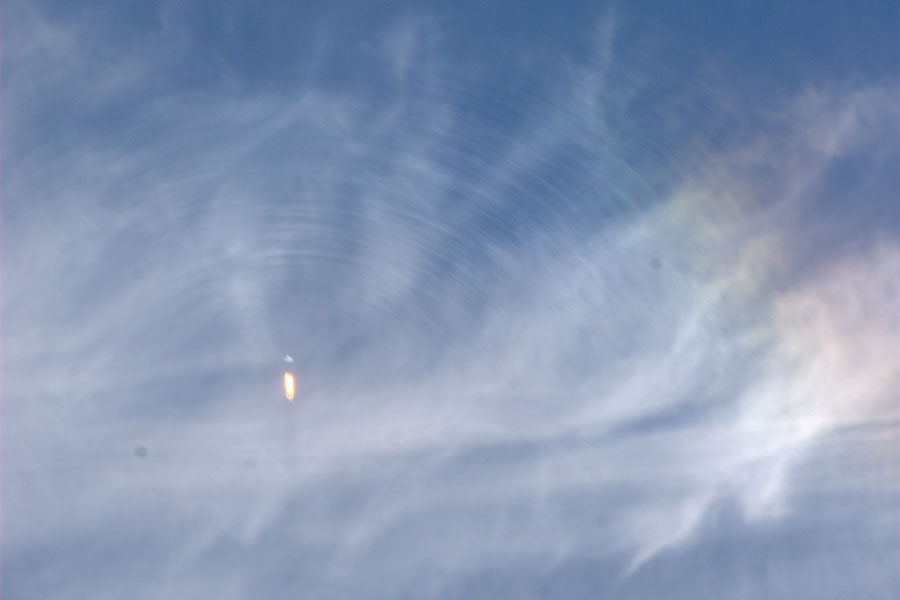
What created those rocket waves, and why did they destroy that sun dog? Close inspection of the above image shows not only a rocket rising near the center, but unusual air ripples around it and a colorful sundog to the far right. The rocket, carrying the Solar Dynamics Observatory (SDO), lifted off two weeks ago from Cape Canaveral, Florida, USA into a cold blue sky. The SDO is designed to observe the Sun continuously over the next several years, exploring the Sun's atmosphere at high resolution and fast time scales. The air ripples -- seen about one minute after launch -- were unexpected, as was the sudden disappearance of the sundog after the ripples passed. Noticed and recorded by several onlookers, there has been much speculation about the origin of the ripples. A leading hypothesis holds that the ripples resulted from a sonic boom created as the rocket broke the sound barrier, which then jumbled a thin layer of ice crystals that were aligned to create the sundog. Lingering questions include why other rocket launches don't produce air ripples as noticeable, and why the ripples appeared more prominent above the rocket. If you know of images of any other aircraft or spacecraft that have produced similar air ripples, please post them to the discussion thread -- they may be help create a better understanding of the effect.
[Source: antwrp.gsfc.nasa.gov]
2.22.2010
2.04.2010
Planetary Skin Institute - Global Surveillance Infrastructure
"NASA and Cisco Systems welcome you to the prison planet, a global surveillance infrastructure is being built up. This is total 'control' and monitoring on all activity on earth. Just imagine feeding this data into an artificial intelligence."
- RedIceHenrik
[But, What is the Planetary Skin R&D program?...]
[*]The Challenge
[*]The Solution
[*]Planetary Skin Institute will research, develop and prototype an approach to provide near-to-real-time global monitoring of environmental conditions and changes. This will deliver the required decision support capabilities to manage global resources, risks and build environmental markets.
Planetary Skin proposes an open and unifying approach to develop the required decision support capabilities to manage global resources, risks and enable the necessary environmental markets.
'Flying blind' in a complex and volatile world.
[*]The Solution
Creating a global nervous system to sense, predict and act.
[*]Planetary Skin Institute will research, develop and prototype an approach to provide near-to-real-time global monitoring of environmental conditions and changes. This will deliver the required decision support capabilities to manage global resources, risks and build environmental markets.
Planetary Skin proposes an open and unifying approach to develop the required decision support capabilities to manage global resources, risks and enable the necessary environmental markets.
[*Straight from www.planetaryskin.org]

12.12.2009
11.10.2009
Google unveils protocol for an interplanetary internet
http://www.wired.co.uk/news/archive/2009-11/06/google-unveils-protocol-for-an-interplanetary-internet.aspx


The Delay-Tolerant Networking (DTN) protocol emerged from work first started in 1998 in partnership with Nasa's Jet Propulsion Laboratory. The initial goal was to modify the ubiquitous Transmission Control Protocol (TCP) to facilitate robust communications between celestial bodies and satellites.
Cerf and his team were eventually forced to acknowledge (ACK?) that TCP simply couldn't cut the mustard, with massive delay and data loss caused by celestial motion rendering TCP useless.
"There was a little problem called the speed of light," joked a typically playful Cerf, as he outlined the idea to the OpenMobileSummit conference in San Francisco. "When Earth and Mars are closest, we're 35 million miles apart, and it's a three and a half minute trip one way, seven minutes for a round trip. Then when we're farthest apart, we're 235 million miles – 20 minutes one way, 40 minutes round trip."
Those pesky planets. But surely Google, having dominated Earth, could do something about that? "The planets rotate, and we haven't figured out how to stop that," Cerf admitted.
The core issue is that TCP assumes a continuous (and fairly reliable) connection. DTN makes no such assumptions, requiring each node to buffer all of its packets until a stable connection can be established. Whereas TCP will repeatedly attempt to send packets until they are successfully acknowledged, DTN will automatically find a destination node with a reliable connection, and then send its payload just once. Given the latency of space communications and the minimal power restrictions placed upon satellites, DTNs approach seems prudent.
However most people don't have a need for regular satellite communication (well, our columnist Warren Ellis has that death ray of his), but Cerf sees his robust protocol having more down-to-Earth applications. Mobile networks, for example, must regularly cope with long periods of delay or loss – a train tunnel rudely interrupting a YouTube stream, for example. Perhaps looking to gain an edge on its competitors, Google has already integrated DTN into Android's networking stack.
Using Android from an asteroid? It's only a matter of time.
[Source: www.wired.co.uk]Cerf and his team were eventually forced to acknowledge (ACK?) that TCP simply couldn't cut the mustard, with massive delay and data loss caused by celestial motion rendering TCP useless.
"There was a little problem called the speed of light," joked a typically playful Cerf, as he outlined the idea to the OpenMobileSummit conference in San Francisco. "When Earth and Mars are closest, we're 35 million miles apart, and it's a three and a half minute trip one way, seven minutes for a round trip. Then when we're farthest apart, we're 235 million miles – 20 minutes one way, 40 minutes round trip."
Those pesky planets. But surely Google, having dominated Earth, could do something about that? "The planets rotate, and we haven't figured out how to stop that," Cerf admitted.
The core issue is that TCP assumes a continuous (and fairly reliable) connection. DTN makes no such assumptions, requiring each node to buffer all of its packets until a stable connection can be established. Whereas TCP will repeatedly attempt to send packets until they are successfully acknowledged, DTN will automatically find a destination node with a reliable connection, and then send its payload just once. Given the latency of space communications and the minimal power restrictions placed upon satellites, DTNs approach seems prudent.
However most people don't have a need for regular satellite communication (well, our columnist Warren Ellis has that death ray of his), but Cerf sees his robust protocol having more down-to-Earth applications. Mobile networks, for example, must regularly cope with long periods of delay or loss – a train tunnel rudely interrupting a YouTube stream, for example. Perhaps looking to gain an edge on its competitors, Google has already integrated DTN into Android's networking stack.
Using Android from an asteroid? It's only a matter of time.
9.17.2009
Terraforming Mars - El proyecto más extraño de la NASA
http://starviewer.wordpress.com/2009/09/15/terraforming-mars-el-proyecto-mas-extrano-de-la-nasa/

Leer más...

Retrocedamos un poco en el tiempo:
Año 2000. Sir Arthur Clarke, y otros visionarios, colaboraron en un polémico proyecto en el que ciencia y ciencia ficción, no estaban en absoluto alejadas de la realidad.
En aquellos momentos, NASA y ESA, buscaban científicos que tuvieran la capacidad de traducir la imaginación en ciencia. Así, surgió uno de los más increíbles y complejos proyectos jamás imaginados por el ser humano: Terraformar Marte.
Para ello, se constituyó un equipo de eminentes personalidades procedentes de todos los campos del saber, al objeto de generar un SCRUM Exocientífico que permitiera nada menos que convertir Marte en una Tierra2. Eran tiempos gloriosos para la recién acuñada exobiología, y así, comenzó este proyecto.
Inicialmente, dicho equipo estaba compuesto por:
- Sir Arthur C. Clarke – Award-winning author of “2001, A Space Odyssey” (Clarke will take part via teleconference from his home in Sri Lanka)
- Kim Stanley Robinson – Hugo & Nebula award-winning author of the “Mars Trilogy”
- Greg Bear – Hugo & Nebula award-winning author of “Moving Mars”
- Dr. James Kasting – professor of geoscience at Pennsylvania State University
- Dr. Christopher McKay – planetary scientist at NASA Ames Research Center
- Dr. John Rummel – planetary protection officer, NASA
- Dr. Lisa Pratt – NASA Astrobiology Institute subsurface group, Indiana University
Leer más...
9.03.2009
In Search of Antimatter Galaxies
http://www.physorg.com/news169739995.html


NASA's space shuttle program is winding down. With only about half a dozen more flights, shuttle crews will put the finishing touches on the International Space Station (ISS), bringing to an end twelve years of unprecedented orbital construction. The icon and workhorse of the American space program will have finished its Great Task.
[...]
An act of Congress in 2008 added another flight to the schedule near the end of the program. Currently scheduled for 2010, this extra flight of the shuttle is going to launch a hunt for antimatter galaxies.
The device that does the actual hunting is called the Alpha Magnetic Spectrometer--or AMS for short. It's a $1.5 billion cosmic ray detector that the shuttle will deliver to the ISS.
[...]
Antimatter galaxies, dark matter, strangelets--these are just the phenomena that scientists already know about. If history is any guide, the most exciting discoveries will be things that nobody has ever imagined. Just as radio telescopes and infrared telescopes once revealed cosmic phenomena that had been invisible to traditional optical telescopes, AMS will open up another facet of the cosmos for exploration.
[...]
Another mystery that AMS will help solve is the nature of dark matter. Scientists know that the vast majority of the universe is actually made of unseen dark matter rather than ordinary matter. They just don't know what dark matter is. A leading theory is that dark matter is made of a particle called the neutralino. Collisions between neutralinos should produce a large number of high-energy positrons, so AMS could prove whether dark matter is made of neutralinos by looking for this excess of energetic positrons.
Read more...[...]
An act of Congress in 2008 added another flight to the schedule near the end of the program. Currently scheduled for 2010, this extra flight of the shuttle is going to launch a hunt for antimatter galaxies.
The device that does the actual hunting is called the Alpha Magnetic Spectrometer--or AMS for short. It's a $1.5 billion cosmic ray detector that the shuttle will deliver to the ISS.
[...]
Antimatter galaxies, dark matter, strangelets--these are just the phenomena that scientists already know about. If history is any guide, the most exciting discoveries will be things that nobody has ever imagined. Just as radio telescopes and infrared telescopes once revealed cosmic phenomena that had been invisible to traditional optical telescopes, AMS will open up another facet of the cosmos for exploration.
[...]
Another mystery that AMS will help solve is the nature of dark matter. Scientists know that the vast majority of the universe is actually made of unseen dark matter rather than ordinary matter. They just don't know what dark matter is. A leading theory is that dark matter is made of a particle called the neutralino. Collisions between neutralinos should produce a large number of high-energy positrons, so AMS could prove whether dark matter is made of neutralinos by looking for this excess of energetic positrons.
8.31.2009
Global UFO Event to Occur in 2010?
After a short time of reverse engineering Alien crafts the human race has not only developed UFO type crafts but has also deployed large star like battleships where smaller crafts are launched from just like at sea. It seems that many of the rumors regarding NASAs joint venture with the Navy to create a space fleet may be true. As mentioned in earlier articles, we exclusively interviewed Jo Ann Richards in a small cafe in Sacramento who told us the same story. It seemed out there but something we would consider with an open mind.
Now the very same information has surfaced
through another informant with credibility.
Why, you may ask. According to Dick Criswell the human race race has been engaged in space battles and is also working with other factions of governments around the world to complete a project to deploy an array of optical satellites equipped with pulse weaponry before the year 2010.
The expected global ET event will change the world as we know it.
The result will be a one world order.

8.30.2009
Los proyectos de la NASA peligran por falta de presupuesto
· Los expertos creen que sin más dinero será difícil volver pronto a la Luna, por no hablar de llegar a Marte.
· Algunos ven en la dificultad de realizar proezas espaciales un signo de declive.
http://www.lavanguardia.es/ciudadanos/noticias/20090830/53774123804/los-proyectos-de-la-nasa-peligran-por-falta-de-presupuesto-luna-estados-unidos-union-sovietica-bush-.html


· Algunos ven en la dificultad de realizar proezas espaciales un signo de declive.
http://www.lavanguardia.es/ciudadanos/noticias/20090830/53774123804/los-proyectos-de-la-nasa-peligran-por-falta-de-presupuesto-luna-estados-unidos-union-sovietica-bush-.html
Estados Unidos, que hace cuarenta años llevó al hombre a la Luna, sería incapaz de hacerlo ahora. Por no hablar de Marte.
"Sólo en el ámbito de los vuelos tripulados al espacio celebramos el aniversario de un logro que parece más difícil de repetir ahora que de realizarlo la primera vez", escribió en 'The Washington Post' Michael Griffin, ex número uno de la NASA (iniciales de la Administración Nacional de la Aeronáutica y el Espacio), al celebrarse el aniversario de la llegada a la Luna.
[...]
El presidente Barack Obama, ocupado en sacar al país de la recesión y en acometer reformas de calado como la de la sanidad, afronta en las próximas semanas otra decisión compleja. ¿Qué hacer con la NASA? [Bueno, realmente, la pregunta sobra. Sin dinero no se podrá hacer nada con la NASA -no con nadie. ¿Qué se siente al haber tirado billones al agujero negro del rescate financiero y ver como ya no hay dinero para nada, para nadie -ni para la NASA?]
Sobre el papel, los objetivos, definidos por el anterior presidente, George W. Bush, y ratificados por Obama, son claros: volver a la Luna en el 2020. Más allá, el objetivo es Marte. En realidad, este es el único objetivo comparable simbólicamente con la llegada a la Luna en 1969.El problema es sencillo: no hay dinero. "La ambición excede al presupuesto", constata Howard McCurdy, catedrático de la American University y especialista en política espacial.
Leer más..."Sólo en el ámbito de los vuelos tripulados al espacio celebramos el aniversario de un logro que parece más difícil de repetir ahora que de realizarlo la primera vez", escribió en 'The Washington Post' Michael Griffin, ex número uno de la NASA (iniciales de la Administración Nacional de la Aeronáutica y el Espacio), al celebrarse el aniversario de la llegada a la Luna.
[...]
El presidente Barack Obama, ocupado en sacar al país de la recesión y en acometer reformas de calado como la de la sanidad, afronta en las próximas semanas otra decisión compleja. ¿Qué hacer con la NASA? [Bueno, realmente, la pregunta sobra. Sin dinero no se podrá hacer nada con la NASA -no con nadie. ¿Qué se siente al haber tirado billones al agujero negro del rescate financiero y ver como ya no hay dinero para nada, para nadie -ni para la NASA?]
Sobre el papel, los objetivos, definidos por el anterior presidente, George W. Bush, y ratificados por Obama, son claros: volver a la Luna en el 2020. Más allá, el objetivo es Marte. En realidad, este es el único objetivo comparable simbólicamente con la llegada a la Luna en 1969.El problema es sencillo: no hay dinero. "La ambición excede al presupuesto", constata Howard McCurdy, catedrático de la American University y especialista en política espacial.
8.07.2009
La sonda Kepler confirma la existencia de un enorme y candente planeta extrasolar
·Según la NASA, HAT-P-7B es comparable en tamaño a Júpiter y gira en torno a una estrella similar a nuestro Sol.
http://www.lavanguardia.es/ciudadanos/noticias/20090806/53759656686/la-sonda-kepler-confirma-la-existencia-de-un-enorme-y-candente-planeta-extrasolar-nasa-tierra-jupite.html


http://www.lavanguardia.es/ciudadanos/noticias/20090806/53759656686/la-sonda-kepler-confirma-la-existencia-de-un-enorme-y-candente-planeta-extrasolar-nasa-tierra-jupite.html
[Izq., Júpiter. Der., HAT-P-7B]
La sonda Kepler ha confirmado la existencia de un enorme planeta fuera del sistema solar.
[...]
El nuevo exoplaneta ha sido identificado como HAT-P-7B y forma parte del casi medio centenar de planetas extrasolares descubiertos hasta la fecha mediante observaciones desde Tierra.
Según científicos del Centro Ames de Investigaciones de la NASA, es comparable en tamaño a Júpiter y gira en torno a una estrella similar a nuestro Sol. Según el astrónomo de la NASA, William Borucki, la detección de HAT-P-7B se verificó tras el análisis de datos de más de 50.000 estrellas enviados por la sonda. Esos datos revelan que el exoplaneta podría tener una temperatura durante el día de unos 1.500 grados centígrados y una atmósfera completamente absorbente, señaló.
[...]
Según Ed Weiler, director de misiones científicas de la NASA, se trata de responder al enigma que el Hombre se ha planteado desde los albores del conocimiento: ¿Hay vida en otros lugares o estamos solos en el Universo?, que no es "un interrogante científico, es una pregunta humana básica", señaló.

Leer más...[...]
El nuevo exoplaneta ha sido identificado como HAT-P-7B y forma parte del casi medio centenar de planetas extrasolares descubiertos hasta la fecha mediante observaciones desde Tierra.
Según científicos del Centro Ames de Investigaciones de la NASA, es comparable en tamaño a Júpiter y gira en torno a una estrella similar a nuestro Sol. Según el astrónomo de la NASA, William Borucki, la detección de HAT-P-7B se verificó tras el análisis de datos de más de 50.000 estrellas enviados por la sonda. Esos datos revelan que el exoplaneta podría tener una temperatura durante el día de unos 1.500 grados centígrados y una atmósfera completamente absorbente, señaló.
[...]
Según Ed Weiler, director de misiones científicas de la NASA, se trata de responder al enigma que el Hombre se ha planteado desde los albores del conocimiento: ¿Hay vida en otros lugares o estamos solos en el Universo?, que no es "un interrogante científico, es una pregunta humana básica", señaló.

[Exoplanetas conocidos... Son casi 50!]
[...animation]


Subscribe to:
Posts (Atom)


